
“Let’s get married! After all, we can always get divorced if things don’t work out…” Nothing shouts commitment like a good caveat. Although it’s not a new phenomenon, the trend of “I’m in…maybe” is growing between employers and employees in today’s workplaces. More and more, survival in the current employment environment means keeping options open and viewing your exit as a given, instead of a possibility. Looking for the next opportunity, even as you’re starting a new one today.
If the mindset is always what’s next, how does that impede team development? If the team doesn’t develop as a committed unit, what happens to employee engagement? The impact of engagement is undeniable, which is why an optimized people development system, one that seeks to understand those it serves, is so important.
It is easy to understand how this dynamic has developed. This is self-protection in an era where the meaning and purpose of a job continues to change. In a thought provoking Forbes article, Nirit Cohen shares some compelling reasons for these changing dynamics in modern workplaces, “People will not anchor their identity to institutions that do not help them grow. The organizations that succeed will not be the ones that demand commitment, but the ones that remain useful. When work no longer defines who we are, the only organizations that matter are the ones that help us become who we need to be next.” Useful. How does a company remain useful to employees who define a career path so very differently?
Loyalty went away
This evolution of attitude goes back further than Covid and AI. Gallup’s annual survey and others show that the trend has been developing for 30 years or more. Even before that, we saw loyalties – from both the company and the employee – began to change back in the 1980’s. When various shifts brought an end to the idea of lifetime employment and a happy retirement with one company. Each party has become expendable in the view of the other. The pandemic and technology only exacerbated the situation.
Today, people relate to their jobs differently. Cohen opines that, “Perhaps disengagement is not withdrawal so much as diversification. People who no longer define themselves by a single job experience layoffs as a transition between expressions of their capability, not as a collapse of self. The job mattered. It simply did not define them.”
The article focuses on knowledge workers; however, other industries should pay attention as well. Attitudes toward work tend to seep over boundaries and spread as workers mix and mingle and share experiences and ideologies.
So, is there a next here?
“When people can walk away psychologically before they walk away contractually, retention strategies built on fear, prestige, or inertia stop working.” Underneath Cohen’s statement are some simple questions and a challenge; do we know what our retention strategy is built upon? How can we improve our strategy in this area and create significant distance between now and what’s next?
The obvious starting point is a careful examination of the current retention strategy. Gather the PDS stakeholders and explore the foundational elements of this part of the system (the Talent Stream Map can help with this). What assumptions are at its base? Does the process value individual growth? What adjustments should be made to ensure that these values are embedded into the delivery of retention efforts across the PDS? The team will undoubtedly have many questions.
Although the article does not address the relational aspects of a job, we know relationships are a vital part of retention. In fact, a great deal of individual growth is supported in and through relationships with colleagues. Relationship building is facilitated through a strong PDS. Coaches that help explore one’s potential and can help team members see what’s next within the organization help keep those members engaged. Look at the PDS and assess the system’s ability to train and deploy a cadre of coaches.
Teams that tackle meaningful challenges together can also create stickiness. Those charged with leading these teams should be trained in emotional intelligence and should understand that team building is one of their primary responsibilities. Does the PDS support leaders in this way?
With the new mindset as described, tracking development and growth is another way to promote retention. An optimized PDS uses tools like development pathways to communicate what is expected but also these serve as an effective reminder of their growth trajectory. Development pathways provide a connection between the organization and the individual where both can explore and continually focus on the value each brings to the equation.
We may not like it, but market dynamics are what they are. Employee engagement is an emotional response, and, in this environment, people seem less compelled to connect and commit at this level. The optimized PDS is empathetic, fosters relationships through coaching and team building, and constantly communicates with team members that the best “next” is right where they are, on this team.
Image by Gerd Altmann from Pixabay




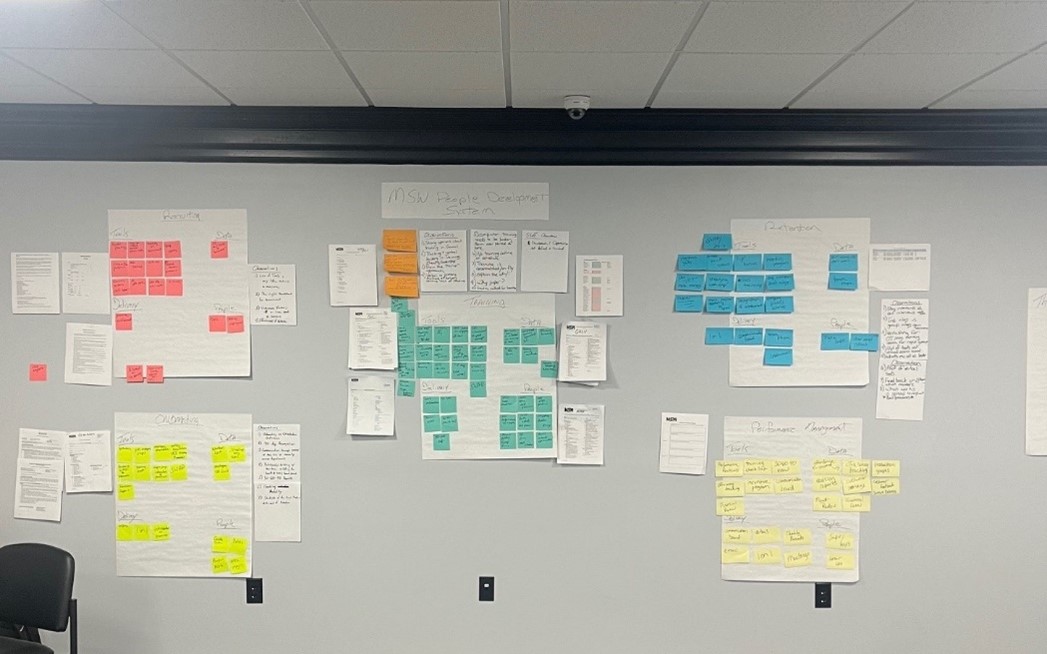


 The Optimized People Development System