Category: employee-engagement

  • Now vs Next – A Retention Challenge

    Now vs Next – A Retention Challenge

    “Let’s get married! After all, we can always get divorced if things don’t work out…” Nothing shouts commitment like a good caveat. Although it’s not a new phenomenon, the trend of “I’m in…maybe” is growing between employers and employees in today’s workplaces. More and more, survival in the current employment environment means keeping options open and viewing your exit as a given, instead of a possibility. Looking for the next opportunity, even as you’re starting a new one today.

    If the mindset is always what’s next, how does that impede team development? If the team doesn’t develop as a committed unit, what happens to employee engagement? The impact of engagement is undeniable, which is why an optimized people development system, one that seeks to understand those it serves, is so important.

    It is easy to understand how this dynamic has developed. This is self-protection in an era where the meaning and purpose of a job continues to change. In a thought provoking Forbes article, Nirit Cohen shares some compelling reasons for these changing dynamics in modern workplaces, “People will not anchor their identity to institutions that do not help them grow. The organizations that succeed will not be the ones that demand commitment, but the ones that remain useful. When work no longer defines who we are, the only organizations that matter are the ones that help us become who we need to be next.” Useful. How does a company remain useful to employees who define a career path so very differently?

    Loyalty went away

    This evolution of attitude goes back further than Covid and AI. Gallup’s annual survey and others show that the trend has been developing for 30 years or more. Even before that, we saw loyalties – from both the company and the employee – began to change back in the 1980’s. When various shifts brought an end to the idea of lifetime employment and a happy retirement with one company. Each party has become expendable in the view of the other. The pandemic and technology only exacerbated the situation.

    Today, people relate to their jobs differently. Cohen opines that, “Perhaps disengagement is not withdrawal so much as diversification. People who no longer define themselves by a single job experience layoffs as a transition between expressions of their capability, not as a collapse of self. The job mattered. It simply did not define them.”

    The article focuses on knowledge workers; however, other industries should pay attention as well. Attitudes toward work tend to seep over boundaries and spread as workers mix and mingle and share experiences and ideologies.

    So, is there a next here?

    “When people can walk away psychologically before they walk away contractually, retention strategies built on fear, prestige, or inertia stop working.” Underneath Cohen’s statement are some simple questions and a challenge; do we know what our retention strategy is built upon? How can we improve our strategy in this area and create significant distance between now and what’s next?

    The obvious starting point is a careful examination of the current retention strategy. Gather the PDS stakeholders and explore the foundational elements of this part of the system (the Talent Stream Map can help with this). What assumptions are at its base? Does the process value individual growth? What adjustments should be made to ensure that these values are embedded into the delivery of retention efforts across the PDS? The team will undoubtedly have many questions.

    Although the article does not address the relational aspects of a job, we know relationships are a vital part of retention. In fact, a great deal of individual growth is supported in and through relationships with colleagues. Relationship building is facilitated through a strong PDS. Coaches that help explore one’s potential and can help team members see what’s next within the organization help keep those members engaged. Look at the PDS and assess the system’s ability to train and deploy a cadre of coaches.

    Teams that tackle meaningful challenges together can also create stickiness. Those charged with leading these teams should be trained in emotional intelligence and should understand that team building is one of their primary responsibilities. Does the PDS support leaders in this way?

    With the new mindset as described, tracking development and growth is another way to promote retention. An optimized PDS uses tools like development pathways to communicate what is expected but also these serve as an effective reminder of their growth trajectory. Development pathways provide a connection between the organization and the individual where both can explore and continually focus on the value each brings to the equation.

    We may not like it, but market dynamics are what they are. Employee engagement is an emotional response, and, in this environment, people seem less compelled to connect and commit at this level. The optimized PDS is empathetic, fosters relationships through coaching and team building, and constantly communicates with team members that the best “next” is right where they are, on this team.

    Image by Gerd Altmann from Pixabay

  • Can Your System Achieve Employee Engagement?

    Can Your System Achieve Employee Engagement?

    For over a quarter of a century employee engagement has been dismal. Difficulty in defining the concept has had a lot to do with this stagnation. However, a shared vision of a truly engaged workplace by all stakeholders is possible with an attentive people development system. A PDS intent upon moving the needle on this stubborn but important metric.

    When the phrase appears, employee engagement generally implies that an individual has a deep level of commitment, a strong willingness to be involved, or a high degree of dedication to being a part of the team and excelling at their work. The word excitement often shows up in the definition, sometimes the word motivation, and happiness might also appear.

    Some explanations seem to border on the concept of achieving a state of mental flow, suggesting that engagement is being fully absorbed by and enthusiastic about the job. Some days, yeah. Some days, no. Several people that I’ve worked with in the past who were very much bought into the success of the company could seldom be described in these terms. Nevertheless, they understood their connection and responsibility to the team, and they did, on a regular basis, contribute a great deal.

    It’s a complicated concept; one that has changed over the years. Tony Martignetti and Moe Carrick, business leaders and authors, compellingly argue that employee engagement is being replaced by a sense of employee connectedness. Pointing out that the move toward connectedness has been driven by social and cultural forces that have obvious impacts in the workplace.

    Along those lines, I prefer to think of employee engagement as a mutually beneficial harmony reached when both employer and employee recognize and accept their responsibility for the success and well-being of the other. It takes all parties to achieve this harmony, and it takes a responsive PDS to promote and protect it.

    A Shared Understanding.

    Since all stakeholders have a vested interest in this, it seems like a good idea to start by understanding employee engagement very clearly. And though it sounds simplistic, getting all PDS stakeholders on the same page is a good first step in building stronger allegiances.

    It is talked about so much in certain circles that it can lead to assumptions that everyone knows what engagement is and how it matters, which is obviously not the case. Getting everyone’s mental models of this vital connection out in the open and agreeing upon a unifying model can reduce misunderstandings and misinterpretations of the concept.

    Leaders of organizations, just like individual workers, have the right to think about engagement what they will and to have certain expectations about what it takes to achieve this state of harmony. There may be very little distance between the two ideals, or there could be a chasm. Alignment of expectations and agreement around everyone’s responsibilities could mean the difference between dismal performance for another quarter century and levels of engagement that are truly beneficial for all.

    How Far Apart are We?

    One of the primary roles of the PDS is culture building. An engaging culture connects people, shares openly, clarifies goals, promotes learning, and ensures that stakeholders share responsibility for outcomes.

    An optimized PDS helps create space for dialog and allows the whole team to debate the definition of engagement and agree on ways to improve it. This falls easily under the training and development function of the system.

    Start by creating small cross functional teams and share the data – turnover, average tenure, survey results, etc. Let the team know how these numbers impact both the organization and every individual within it. Then ask the teams to help improve the numbers. Everyone benefits when these indicators improve and self-interest is a powerful motivator.

    Part of the retention efforts of the PDS should be to bring senior leaders into community with frontline workers through one-on-one coffee breaks, lunches, or small group brainstorming sessions. These are perfect times to bring up the topic of engagement. Ask questions about engagement, extend the dialog created in the cross functional groups. Discuss the roles that each stakeholder plays and then help them play those roles well.

    These interactions are also great opportunities to further explain how being engaged is in everyone’s best interest. Thanks to the proverbial grapevine, these conversations will find their way back to the entire team. Done well, this can feed into other positive conversations, helping to drive higher levels of commitment.

    Of course, this means that the leaders must be educated on those impacts and trained in having these coaching/development conversations. Another job for the optimized PDS! To be effective, leaders must understand how important employee engagement really is and how they impact it.

    Measure it…But Differently.

    Employee engagement is usually measured via a survey asking people about their state of mind at a particular time. Which can skew the results dramatically, depending upon moods, circumstances, and other life situations.

    Instead, look for and measure individual behaviors that tend to be driven by a higher level of buy-in or consensus. These might include:

    • Number of teams/groups individuals have joined,
    • Number of requests individuals make for development opportunities,
    • Levels of development attained (individual development plans are great for tracking this!),
    • Number of ideas generated per individual,
    • Involvement in and contributions to events (improvement events, community-facing events, peer support events, etc.),
    • Relationships developed (social connections with co-workers, coaching, etc.),
    • Willingness to be part of initiatives,
    • Changes in attendance patterns,
    • Personalization of workspace.

    Keep doing engagement surveys, one on one encounters, and peer evaluations to assess the harmony. Even better, be creative in identifying other more meaningful metrics, realizing that being engaged influences several behavioral and personal performance indicators. Share these measures liberally with the team, encouraging them to value these outcomes.

    Old Systems Will Struggle.

    According to Martignetti and Carrick, “To build connected organizations, leaders must shift from driving engagement to designing relational ecosystems and from motivating individuals to strengthening networks.” Here’s a pressing question; can the organization’s internal people development system support this shift in thinking?

    Look more closely at the system level for opportunities that can move the conversation in the right direction. Systems thinking is one of the three guiding principles of the Optimized People Development System framework because the PDS is a dynamic system and difficult to see. It is also the most important organizational system for fostering connections and relationships.

    Employee engagement has languished far too long. Establishing a shared definition and innovative measures of employee commitment and their wellbeing can help move the numbers in the right direction. An optimized PDS, one that fosters a new mindset around engagement and connection can help keep that movement going.

    Image by Gerd Altmann from Pixabay 

  • Time to Challenge the One-Sided Employee Engagement Push

    Time to Challenge the One-Sided Employee Engagement Push

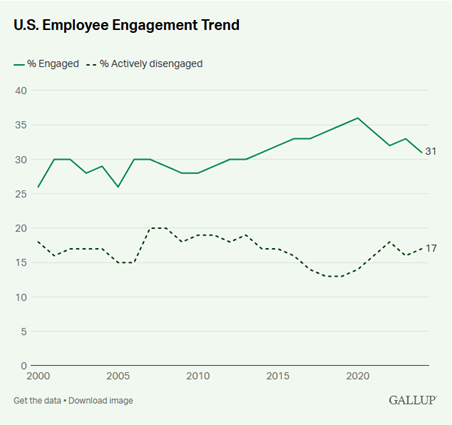
    Stickiness hasn’t changed in the last quarter of a century. According to Gallup’s long running, annual surveys, employee engagement has remained around 30% and active disengagement around 17% since Y2K was a thing. Gallup’s surveys and others confirm that getting people to consistently participate at a higher level desperately needs to be improved.

    Employee engagement is a prime area where improvement can benefit everyone. People are frustrated. Money and productivity are being lost due to low engagement and the negative impacts of a disengaged workforce show up at multiple levels beyond just the workplace.

    Why haven’t we been able to move the needle on the levels of engagement? It’s not like we haven’t been trying. I, and many of my workforce development peers, have been preaching to employers for years the need to create an engaging workplace. And most have been sincere in their attempts to do this demanding work. Still, we hear very regularly that these same employers are struggling to find people who want to work, people who will stick around long enough to see the benefits and advantages of being on the team. Some, including the MikeroweWORKSFoundation, have lamented the loss of the will to work. Maybe we’ve been focusing too much on only one side of the equation.

    Limits to an Engaging System

    Each team member is a system, just as the organization is a system. When these two systems are integrated, both are impacted. So, the probability of success by the organization in building an engaging environment will be limited if the newly integrated systems do not share a common goal around, or even a unifying understanding of the purpose and value of work. If the individual system is unaware of how to engage, unable to engage, or unwilling to engage, how successful can the organizational system’s attempts at engagement be?

    Focus on the Other Part of the Equation

    Here’s a potentially controversial solution – let’s help individual team members appreciate the many values of work and why engaging at work is in their best interest. There are distinct and powerful reasons for individuals to pursue being engaged at work.

    Beyond the obvious economic benefits, work is good for the health – physical, mental, and yes, spiritual health. A good day’s work influences positive feelings toward life. Workplace stress is well documented. How much of this might be relieved with a healthier view of work? Family life benefits when things are good at work. A different mindset about work could help promote this.

    Work is an integral part of the human experience. Always has been, always will be. But it goes beyond just the part of work we get paid for. The theme of work runs all the way through the Christian scriptures starting with the first verse of Genesis. I’m no religious scholar, but a cursory search indicates that work is pretty prominent in many other belief systems as well. We need to help people take a holistic view of work. The whole person comes to the job, so the whole person should be taken into consideration, including the spiritual side.

    Other Benefits

    In future posts we’ll unpack some more details of the benefits and values of work. Looking at the definition of engagement is helpful. So too the way we measure it. Engagement at work is very much an emotional reaction. How do we feel about the work, the people, the mission, and vision of the organization? It is emotionally intelligent for everyone to engage at work. How might we bring EQ into the solution to this challenge? Other topics might find their way in as well. Your thoughts and insights could add immeasurably to this exploration, so I invite you to opine as we explore.

    For years we have, in my opinion, pushed employee engagement mostly from the employers’ side of the equation. Certainly, there is still work to be done by employers; however, the other stakeholders must also take responsibility and do their part to engage and be engaged.

    An Optimized People Development System can be a strong vehicle for change in this effort. Examining the concept of engagement while looking closely at the internal system we depend upon to find, train, and retain people can offer strategic opportunities for improvement. Improvements to the system and the philosophy under which it operates could certainly help the organization and each individual within it, stick together longer over a shared appreciation for the true scope and amazing values of work.

    Image by Mohamed Hassan from Pixabay

  • Yes, AI Will Change This System Too

    Yes, AI Will Change This System Too

    How will artificial intelligence change the internal systems that companies use to find, train, and retain people, what we call their People Development System (PDS)? It will involve more than just the AI tools manufacturing workers use; it will fundamentally change the way the PDS will need to support a culture that embraces AI.

    The NAM (National Association of Manufacturers) recently proposed a series of policy recommendations for policymakers to drive AI development and adoption in manufacturing, which includes a recommendation on developing the manufacturing workforce of the AI age by supporting training programs and career and technical education institutions.”

    New training and strong partnerships, yes. But what must also happen within the company, especially small to midsized makers, for these new changes to make a meaningful difference?

    An optimized PDS will need to be able to support AI by:

    • Promoting systems thinking for all team members.
    • Creating new job descriptions (and then appealing job postings…these are two different things!) that identify new AI and advanced manufacturing skills.
    • Rethinking training approaches utilizing AI tools for certain but also training team members on new ways to think about utilizing AI.  
    • Recognizing the need for new leadership approaches for AI empowered manufacturing teams.
    • Developing new mindsets that allow people to think about and utilize AI and other technologies on the factory floor.
    • Creating a strong culture of learning and experimentation.
    • And so much more.

    AI will change the way manufacturing systems operate. Including the one system that manages the people who operate within those systems.

  • The Missing Part of an Optimized Workplace

    The Missing Part of an Optimized Workplace

    I have been unfair to the organizations I serve. As an advisor and advocate for workforce and workplace development, I have been telling employers for years that they must build great workplaces to attract and retain the talent they need. I have implored them to create people-centered workplaces. I have shown them study after study that insists that without efforts to create great cultures, to make their people feel appreciated, and to ensure that they are investing in the development of their teams, they could expect a lifetime of crippling instability in their workforce. But I failed to recognize an equally important part of the equation.

    Great workplaces are crucial, and most employers understand the need for supportive working environments. But what happens if you take great pains to build a robust environment and engaging culture and then you introduce people into that system with a poor understanding of work, who do not appreciate its value, and its far reaching benefits? That culture will struggle to survive – no matter how hard you work to sustain it.

    Wake-up Call

    “We cannot find people who want to work!” This was my wake-up call. I have been hearing it for years now after helping manufacturers work hard to improve their workplaces. And after this work, time and time again, I hear that people are not staying around long enough for these much-improved cultures to have any impact. It seems apparent that we need to broaden our approach.

    There has been a lot of emphasis on work life balance of late. This is an essential element of consideration, no doubt. However, attitudes about work are also important. Having a balanced understanding of the need for rest and rejuvenation weighed against the absolute need for impactful work, can change the dynamics of the labor market.

    Not a New Debate

    Work has always been a hotly debated topic. Plato thought it was beneath learned people. Martin Luther counted all work, religious and secular, as sacred. Many are fine with work as long as someone else is doing it. Current attitudes seem to lean more toward a grudging acceptance if it pays well. We’d really rather talk about retirement. Preferably before the age of forty.

    We need to work. Work is impactful in so many ways. Economically, when everyone that can work is at work, everyone benefits. Socially, when people work, society works. Spiritually, we were created to work and to serve one another. Individually, work can be a form of self expression. There are health benefits that come from work. Benefits that spill over into families and communities. And the list goes on.

    Balancing the Approach

    It is abundantly clear that we do actually need great workplaces; people-centered workplaces. But if we are going to engage more people in the workforce, we must appeal to something more. We must help people recover a healthy attitude about doing the work. About investing their efforts and time into something that is bigger than themselves.

    There are many complex challenges in our efforts to develop a stable and vibrant workforce, and they will not be solved with simple ideas and solutions. However, if we include in those solutions efforts to reenforce the value of work and begin to shift societal opinions and attitudes toward a better vision of work, we can fill those people-centered workplaces with people who appreciate them.

    Image by Richard Reid from Pixabay

  • A Real Tech Savvy Team

    A Real Tech Savvy Team

    It seems like revolutions come around faster and faster these days. In manufacturing, Industry 4.0 has barely taken off and already Industry 5.0 is upon us. Actually, the latter has always been a part of the former, but the focus was definitely one-sided.

    I4.0 is industry jargon for the latest industrial revolution brought on by automation. It encompasses things like robots, multiple types of sensors, artificial intelligence and machine learning applied to the ways that we produce just about everything. Although there has always been, as part of the I4.0 discussion, some consideration of the impact on people, that part of the conversation was seriously overshadowed by the cool factor of the machines.

    The Shift

    Industry 5.0 acknowledges that the humans in the equation matter; they matter a great deal. The European Union sought to add the propre emphasis to I5.0, saying that it, “Provides a vision of industry that aims beyond efficiency and productivity as the sole goals and reinforces the role and the contribution of industry to society. It places the wellbeing of the worker at the centre of the production process and uses new technologies to provide prosperity beyond jobs and growth while respecting the production limits of the planet.”

    This definition is more expansive and recenters the conversation around taking care of important matters. Namely, people, in the workplace and outside of it. We need people with know-how, and we need to take better care of them. This vision of I5.0 also changes the scope of what people need to know.

    Developing tech savvy people used to mean helping them learn to use technology. To understand the “how” of technology. Now, developing the tech savvy workforce of the future includes not only developing their abilities to use technology, but also their ability to think about it, apply it broadly, and grasp the “why” of it.

    A Tech Enabled Team

    Technology can unleash new levels of creativity and ingenuity, not just from a select few team members with specialized training, but from many members of the team. The people doing the work can offer great insight as to how to automate it. They will also be able to help identify other opportunities to automate, once they understand the broader reasons driving the Industrial Revolution.

    Developing technology skills will certainly reach beyond their work life as well. Artificial intelligence tools are accessible to everyone, and the pressure is on for everyone to learn how to use them at work and in other areas of life.

    The organization that has a tech savvy team, from the lowest to the highest positions, will have a distinct and significant competitive advantage. For example, imagine a team of people who are well versed in problem solving techniques. Now imagine that they also understand how to leverage AI in this effort, at the right time and in the right way. There are multiple benefits that could result from this combined approach. Not the least of which is the opportunity to learn from AI when technology suggests a path that has yet to be considered.

    Certainly, there must be some determined efforts to promote critical thinking and prevent the total abdication of human thought in the process. People should not simply surrender to technology but should cultivate their ability to envision uses for cobots and robots, the placement of sensors, or even to correctly prioritize data.

    An Engaging Scenario

    Technology is relentlessly pushing the frontiers of work. It is an exciting time, but for some, it can be frightening. Fear of losing jobs and being irrelevant in the new industrial revolution is pervasive. The warning – AI won’t take your job, but someone who knows how to use AI could – is just as ominous for the frontline worker as it is for the front office worker or the engineer.  

    When organizations include everyone on the team in the transformation to I5.0 and involves them in the conversations, the exploration, and the development of capabilities, an engaging culture becomes a healthy byproduct of the transformation.

    Technology is prevalent in many facets of life, particularly in the workplace and in the home. Helping people understand technology and use it effectively and responsibly, is helpful in those various facets of life. Studies show that individuals are adopting technology faster than most employers are. Organizations that tap into this interest and excitement will have a better experience as the industrial revolutions roll on.  

    Image by Matías Flores from Pixabay

  • Chasing and Catching in the People Development System

    Chasing and Catching in the People Development System

    Define What to Chase

    The duration of the chase

    Determination in the chase

    Wrapping up the principles

  • The Flow and Pull of Human Inventory – A Lean Perspective

    The Flow and Pull of Human Inventory – A Lean Perspective

    It just sounds wrong to ask such a question. It feels insensitive, almost Orwellian in a way. Should people be considered inventory? Applying lean thinking to a system requires that we look at all the components, and inventory can certainly be a major factor. But, in this case, we’re not talking about a store of things, a list of items on shelves or in boxes. We’re talking about people.

    Inventory is one of the famous wastes in lean thinking. Usually, the goal is not to have too much or have it before it’s needed; this is because lean concepts originated from manufacturing. However, applying lean concepts to a people development system (PDS) can challenge the definition of inventory.

    Exactly Where are the People?

    I was talking to a colleague about helping organizations optimize their PDS by applying lean thinking. As we discussed how to analyze the traditional wastes of lean, my friend suggested that the stack of applications that an organization has for open job postings represents a type of inventory. That stack could be seen as an inventory of raw materials ready to be processed by the PDS. Potential, raw talent, waiting to be built up.

    Extending the analogy, perhaps these are other types of human inventories: 

    • Work in Progress – Those individuals involved in training and development.
    • Finished Goods – No one is ever fully finished learning, but these are reaching their peak in their role.
    • Reworks – those who recognize the need to change and are open to the idea of upskilling and retraining.
    • Obsolete Inventory – those people in the organization who refuse to change or whose roles are disappearing.

    There is also just the overall headcount. Donella Meadows, a leading contributor to systems thinking, often referred to stocks as the foundation of any system. She bolsters this assertion saying, “Stocks are the elements of the system that you can see, feel, count, and measure at any given time.” In the people development system, headcount is the stock, making it a type of inventory; one that can fluctuate by being acted upon by a system’s feedback loops, either a balancing loop or a reinforcing loop, or a combination of both. The PDS is responsible for maintaining the stock of people in all the organizational systems.

    Working Their Way Through the System

    Looking at people as inventory in some instances can be helpful. For example, two key lean principles are establishing flow and creating a pull system.

    Flow

    In this instance, flow represents people successfully moving through the system. It happens when the recruiting process is continually finding and developing acceptable/trainable talent at all key positions. It is created by constantly looking for valuable attributes and talents, even if there is no signal from internal customers. Then, creating the opportunity for those attributes and talents to “flow” into other parts of the organization; for the good of the individual and the organization.

    Flow is not just about people physically moving through the system though. It is also about intellectual movement, emotional movement, and cognitive movement. Flow implies progress and growth. The optimized PDS creates flow by ensuring that everyone is moving (upwardly, laterally) – progressing along their development path, career ladder, skill levels, etc.

    Pull

    Pull is demand. It is created in the organization when there’s a need for people to move up, take on new roles, or add their capabilities to another team. Pull is established when organizational systems have a need for people due to growth, expansion, and success. The Optimized PDS helps find the right types of human inventory, at the right place, in the right quantity.

    Pull is driven by more than just promotions. There’s also skill level advancement and growth in leadership abilities, cognitive training, personal goal attainment, knowledge acquisition, coaching ability, cross-training in other areas, concept understanding (such as lean, kata, systems thinking, etc.), and strategic thinking.

    Signals From the System

    Together, the lean concepts of flow and pull help PDS stakeholders identify where needs are greatest and the pulling forces are strongest. These signals get transmitted back through the PDS so that the demand is met, people are added, they get training, are moved, etc. They will have names and faces, of course. They won’t be known as Works in Progress, or Reworks, or Obsolete. They will, however, be seen in the system.

    There are places in the PDS where monitoring the levels of human inventory and their developmental progress can interject a sense of urgency to ensure that people are efficiently moving through the system and they are being served well along their journey. Just the idea of labeling people as inventory may be inflammatory or sound demeaning to some. If it is meant to value people only as so many interchangeable resources to be manipulated, then it would be offensive. However, observing the PDS through this lens can help us gain a more systems-oriented view and help us manage the organization’s most important inventory.

    Reference – D. H. Meadows, (2008). Thinking in Systems, A Primer.

    Image by Gerd Altmann from Pixabay

  • Just how Powerful are Your People?

    Just how Powerful are Your People?

    Everyone has some amount of power – even if it isn’t much. I remember discussing this idea on several occasions in my graduate studies in educational psychology. The learner has power in the system meant to grant them access to knowledge.

    They have the power to choose to participate; they can determine at what level to affect outcomes within the class; and, if given the opportunity, they even have the power to shape the curriculum.

    The point is; they bring something to the table that is important for the system’s success and survival. They also bring this type of power to the workplace. 

    Some may look at an organization’s people development system and think that generally the power flows in one direction. After all, the organization offers training, development, and other growth opportunities. Employees receive these benefits and find security, safety, potential success, etc.

    However, the caretakers of an optimized PDS understand the nature of shared power and seek to use it to continuously improve their system.

    According to the American Psychological Association, reciprocal determinism, “…maintains that the environment influences behavior, behavior influences the environment, and both influence the individual, who also influences them.” A concept largely attributed to Albert Bandera’s work in social learning theory.

    The people served by the PDS are beneficiaries but also benefactors; customers but also value adders; free agents that can either help or harm.

    Respecting and enabling these give-and-take relationships can help ensure that the undeniable power possessed by employees gets invested back into the organization.

    The Power to Choose

    People get to decide whether or not to contribute; they can selectively add value; they can deliberately enhance organizational pride; they can intentionally choose to be a positive force in the culture. They can do all of these and more – or not.

    They can choose to learn, to strengthen communication, or to underperform. They can elect to exercise their power to help attract talent, to help train that new talent, and to help retain it. Even if they are not directly involved as stakeholders of the people development system.

    The best people development systems use tools like development pathways that help clarify available choices and encourage greater engagement. These top-notch systems acknowledge contributions and are careful to recognize the value that each person chooses to bring.

    The Power to Effect

    The collective motivations of individuals drive an organization’s efforts. Inspired people pour extra energy into their work and their teams. That extra energy underpins stronger relationships, fuels creativity, or simply adds to a heightened level of determination to excel. Uninspired people are generally unconcerned about the affect they might have on the team and the organization.

    Leaders of an optimized PDS develop a new appreciation of the idea of engagement. They understand that the power of influence ripples throughout the organization and can enhance the environment even more.

    The Power to Change

    Being adaptable in today’s workplace is a much-desired skill. People who possess the power and willingness to change, continuously upgrade, and repeatedly step out of their comfort zone are highly valued.  

    Yet change requires support from the organization. It requires a culture that celebrates learning and, to a great extent, a culture that embraces failure as a means of moving forward.

    Development processes that not only support these ideas but actively encourage them can attract people who are excited by change and motivate those who might be intimidated by it.

    Recognizing that every individual has some degree of power is a sign of respect. It is an acknowledgment that everyone involved brings something valuable to the table. And that can make a people development system more effective.  

    Image by Gerd Altmann from Pixabay