We often use the journey metaphor when talking about starting a new job. And if you’ve ever had a bad start to any journey, you know how the beginning can impact the whole trip.
TalentLMS and BambooHR recently presented a research report titled Next-gen Onboarding: Redefining the New Hire Journey. While this paper points to generational differences and to the prominence of AI, looking closely at the findings can also help leaders identify system designs and system behaviors that, with targeted improvements, could help people stay for longer journeys.
Ensuring that new team members get a good start is what makes the onboarding portion of an organization’s people development system so very important, and a prime area for system optimization.
6 questions to ask of your PDS.
1 – Is our onboarding approach still heavily orientation focused?
The paper points to the need to invest more time and effort into this early stage. If your approach to integrating new hires is speed oriented – get it done and get to the workstation – then you are probably going to continue to struggle to keep new hires. Orientation is different from onboarding. Many organizations miss this opportunity. Spread the onboarding process out over a long period of time and drop the firehose.
2 – Is our onboarding process informed by and shaped by our retention and training processes?
“65% of employees view onboarding as the start of a continuous learning journey…” So, what happens after onboarding? Does the initial phase of the plan connect seamlessly with the other PDS systems – retention, training, performance management?
Speaking of that continuous learning journey,
3 – How does the new hire know how we will help them grow?
If you’re not using development pathways, now’s the time to start. Share the map of the journey since they are at the starting point. Having an AI assistant involved at this point could be highly effective.
The survey found that during the onboarding process, 39% of new hires admitted to having second thoughts about their decision to join the company. For the youngest generation it was 49%.
4 – Does our onboarding approach instill confidence?
Full customization to suit each person may not feasible, but some adjustments that consider generational differences could help drive success rates higher. An exploration in this area could be very fruitful.
5 – Does our PDS support growth for new hires?
According to Talentlms.com onboarding can often fall short. “When it comes to skill-building, new hires are rushed, left without follow-through, and handed training that doesn’t match their role. If companies want new hires to grow, they need to design onboarding that actually makes room for it.”
Aligning with the onboarding, an optimized PDS supports growth by using personalized development pathways. These help communicate the potential growth, keep team members on track and motivated to achieve the growth, and ensure that all parties benefit from the growth.
6 – Is the communication in the recruiting process supporting onboarding success?
The conversation that began at the recruiting stage should grow and take firm roots in the onboarding process. Showing the prospective team member a template (the development pathway) is also a great start to a successful journey. Communicating with the other PDS stakeholders so they can continue the conversation is also vital.
The onboarding process can often be overlooked when considering continuous improvement opportunities for the people development system. This is a helpful report for teams searching for ways to make improvements to this critical system. It validates the need to understand the supporting elements of the full people development system. Here’s to starting more journeys off well.
Maps have long captured the imagination of countless generations. Whether in search of some fantastic treasure, some lost or forgotten land, or something more practical like finding the way home, maps have played a key role in human civilization. There are many types of maps helping to answer questions like, where are we now, and where are we going? What type of journey will this be, and how should we prepare?
These useful charts are for more than just simply changing physical locations though. Some maps can provide perspective and illuminate potential. Business leaders often use maps to identify improvement opportunities for their systems and processes. There are a few tried and true mapping tools that leaders have relied on for years in these efforts. Choosing the right tool is an important first step.
Lean manufacturing aficionados understand that details are important in pursuit of continuous improvement. The Value Stream Map has been used for years to visually represent all the steps involved in a process. The beauty of the VSM is its ability to show clear connections between process steps, information flows, and material flows.
However, there is a system where the traditional VSM is not the best map to allow a team to see the inner workings of a particularly important system. A system that could certainly benefit from continuous improvement efforts.
Introducing the Talent Stream Map
An organization’s internal workforce development efforts form a system, known by my team as their People Development System. It is comprised by five functional areas – recruiting, onboarding, retention, performance management, and the heart of the system, the training process.
The PDS is a complex, non-linear system. Its functions and activities occur at various times, with multiple stakeholders, in many places across the organization. For example, retention efforts on second shift, multiple training activities on all shifts, and a conversation over lunch regarding performance improvement opportunities. And, of course, the PDS does not produce a “finished” product. People should always be receiving training and getting performance management support. Retention efforts are also never ending.
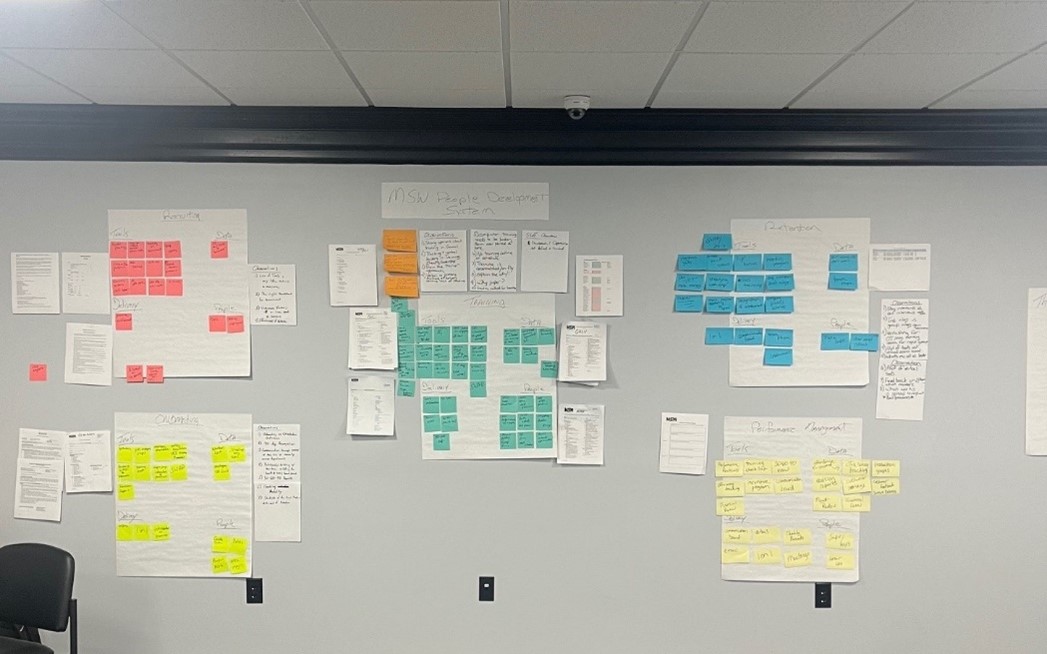
Recognizing the need to help provide visibility to the structure and functions of the PDS and inspired by the Value Stream Map, my team developed the Talent Stream Map, a visual guide of all the components necessary to find, train, and retain people to help an organization meet its strategic goals.
The structure of the TSM
Four drivers
The PDS is empowered and energized by the tools used, data collected, methods of delivery, and the people involved in the processes it houses. Once identified, these components are seen side by side and gaps and opportunities can be explored.
Mapping the tools used in all the processes of the PDS allows the exploration of several helpful questions that can guide the discovery of improvement ideas. For example,
Do we have all the tools needed?
When was the last time tools were updated?
Are we using tools like development pathways effectively across the PDS?
Are we leveraging the tools from one area to another across the whole PDS?
Data is generally collected to help manage the PDS, if only at the basic level, which is fairly easy to track down. Comparing data across the whole of the PDS isn’t as simple. Gathering better data can inform better decisions. When mapped, gaps and opportunities for data collection become more obvious.
What data are we getting and are we actually using it?
What data is missing?
What correlations can be made from data across the five functional areas?
Are we asking the right questions of the data?
Exploring the delivery of the process steps and services helps stakeholders to evaluate the effectiveness of the delivery and to identify potential improvements.
Are the methods of delivery up to date? (this relates to things like technology and to people’s expectations, etc.)
Is the timing of delivery right?
Where are we delivering these steps and services?
How can we improve the delivery?
The people component of the PDS is one of the most important, and one of the most challenging to see. Leaders at all levels contribute to the PDS’s success or failure. Undoubtedly, frontline managers & supervisors impact the process of finding, training, and retaining employees. They are the main avenue of communication within the PDS – their influence even reaches the community. These important stakeholders impact culture, either positively or negatively.
Are the people involved in the PDS aware of their roles?
Are they trained to do their part (in each of the five areas)?
Are they held accountable for the success of the PDS?
How can we help people improve in their PDS related roles?
Once the mapping effort has revealed who is involved with each area and how they are involved, those leaders and stakeholders can visually see how they fit into the system and understand how and why their contributions matter.
The purpose of the TSM
To begin to improve a system, you must first establish its condition. The TSM is intended to make a complex, people-centric system more visible to identify gaps and opportunities that might go unseen otherwise.
After the current state is established and understood, the next logical step is to begin to construct a future state map. This is where the strategy development starts. Stakeholders can make observations, express ideas and concerns, and begin the process of envisioning what the system could potentially look like.
The value of the TSM
Ideally, the TSM is built by all the stakeholders of the PDS. Those being all the individuals who supervise or manage others. As the process unfolds, stakeholders will see parts of the PDS that they may not have seen or fully understood before. There will be conversations that could reveal a misunderstanding of how certain functions are supposed to work versus how they actually work. Ideas, assumptions, and concerns can be voiced. Most importantly, mental models can be aligned, or the recognition of the various mental models can be dealt with.
Waste reduction is the defining hallmark of lean thinking. The TSM helps teams isolate and reduce waste in the people development system. Waste in this system differs from waste in the traditional lean definition. Time, effort, and money are the main types of waste in the PDS, but there are also intangible wastes such as wasted opportunities and wasted potential.
Using the TSM
Making the complexities of the internal workforce development efforts visible can help teams in a number of ways.
Awareness. All stakeholders get a wholistic view of the system and their role within it.
Discovery. Identify gaps and opportunities across one of the most important organizational systems.
Dialog. One of the most valuable aspects of using the TSM is the conversations that occur during the map’s construction.
Business leaders are weary of trying to solve the labor issues we are facing in our state and across the country. The Optimized People Development System and the Talent Stream Map were developed to help these leaders identify often unseen levers that they might manipulate to improve their methods to find, train, and retain the people they desperately need. They help leaders focus more on the things they can control and less on the things they cannot.
The right map can make a journey more successful. The Talent Stream Map helps identify the “You are here” point in a journey toward improving your people development system. It serves as a great guide along the way, and it engages all the system stakeholders as they can make this improvement journey together.
If you would like more information about either of these tools let us know. You can reach me through the comments here or at tim.waldo@tennessee.edu.
Do us a favor please. If you construct a Talent Stream Map with your fellow stakeholders, please send us pictures and share your story. We love to learn how teams use these tools to improve their people development efforts.
The heavy cloud of concern over the American labor force continues to weigh down employers. Frustrated and exasperated leaders at all levels are struggling daily with the difficulty of finding and keeping people. My team at the Tennessee Manufacturing Extension Partnership certainly hears the frustration from those we serve.
Driven by tenacity and a pressing sense of urgency, more business leaders are looking outwardly and investing in long-term solutions with multiple partners while ramping up efforts to attract people to work now. Investing some of that valuable time and effort inwardly could also help address the challenges of finding and keeping a stable workforce.
Look again.
Many manufacturers in Tennessee have already taken a close look at their people development efforts. Some have revisited their policies, some have expanded their benefits, and others have bolstered training and development. Still, there are probably other improvements to be made. In the spirit of continuous improvement, there’s always a chance to dig deeper and uncover new efficiencies and opportunities.
The Optimized People Development System suggests that a good starting place is to create a Talent Stream Map. Based on the value stream map used in lean thinking, the Talent Stream map makes the PDS visible with all its beauty and wonder right alongside all its warts and freckles. Once all the stakeholders have their say and the TS map is complete, it becomes easier to explore possibilities for improvement.
Look deeper.
Asking more questions at more levels of the PDS can reveal overlooked opportunities. How can we improve recruiting is a good question. Can we expand where we recruit is also a good question. How are we attracting potential team members and when does attracting turn into recruiting? Can we do that part better? Digging into why we are recruiting will almost certainly stimulate some interesting discussions that cause other parts of the PDS to be reexamined.
Another good question is, how are our retention efforts? What if we explore how we are personalizing retention? When do we begin our retention efforts in earnest? How can we do that part better? There are many questions that will come from looking more intently at all five areas of the PDS. Challenge the system stakeholders to stretch their question asking skills.
Applying continuous improvement means to constantly ask more questions and explore more possibilities to make things better. If the organization has a good or even a very good people development system, there are surely other improvements that can still be made. Better questions help us to find those hidden opportunities.
Hidden in plain sight.
As the team explores the PDS, they often find things that were obvious, but unnoticed. In one instance, as a group of stakeholders stood in front of their TS map and discussed the flow of communication, they discovered that one tool they were using was not working as designed. They saw this after several questions about how the tool was supposed to be used and when. It was being used, but not consistently and not in the same way by all departments. They suddenly had a meaningful way to improve one of their processes.
Stakeholders of another system unearthed persistent inconsistencies across departments regarding how training was being delivered and even what training was available. Eight supervisors described how they individually understood the company’s training approach, and ultimately discovered that they all had a different understanding of that extremely important aspect of people development.
It has never been tougher to find people to help an organization fulfill its goals and purposes. Looking at and engaging with outward workforce development efforts to ease the struggle is important. However, overlooked improvements in the organization’s internal processes could also help fill positions and keep them filled.
Discovery of these opportunities comes from thoughtful, purposeful exploration at all levels of the PDS and a willingness to dig deeper. Even though you’ve looked already, look again. Go another layer or two in. There just might be overlooked opportunities that could help reduce the amount of frustration and helplessness that your team is dealing with.
The optimization process for the people development system is no different than any other system improvement journey. Start by thoroughly understanding the current system. Mapping the current state of the PDS with all the stakeholders can help uncover the “why” and “how” parts and allow for more precise improvement efforts.
Here’s an article that I wrote about one company’s mapping efforts.
I believe we humans have gotten better at adapting to the pace of change. But the big, pressing changes often distract us from paying attention to other, less obvious adjustments that might make our systems work more effectively. In the last post, we looked at the internal people development systems of organizations and how they are all about change management. These systems manage change and can instigate change. They are also open to transformation to make them more effective.
Seeing the system might be the first change needed
The connections seem obvious; but it is easy for stakeholders to lose sight of them. The PDS is a complex, dynamic system operating at various times, in multiple places throughout the organization, and involving multiple people. The difficulty lies in seeing the whole system in operation.
Change ripples through the system. The training function expands abilities and capacities. Recruiting alters team structure and makeup, while onboarding aims to change perspectives and motivations. Retention seeks to strengthen relationships and boost trajectories while the performance management function improves capabilities and potential. Together, these all work to sustain or change the organizational culture. Inefficiency in one area flows through the system and impacts the other areas.
Weak, neglected connections still allow the system to operate, but with less effectiveness. On the other hand, enhanced connections share data, ensure consistent communication across the PDS, and use tools like training matrices and development pathways to engage teams.
Constant change, aka continuous improvement
It’s often easier to improve a visible, linear system like a production line that makes widgets than to improve a non-linear system that lives within larger systems. But lean thinking can be applied to the PDS.
Adopting a continuous improvement mindset within the team can help ensure that the processes that make up the PDS are focused on delivering value to all of its customers.
Lean thinking is about eliminating waste, which certainly exists within most PDSs. It might be the waste of time that occurs with outdated training methods or poor training tools. It might be wasted opportunities when performance management efforts are ignored. Wasted effort of underdeveloped trainers is another example.
Learning organizations are always changing
Grow the individuals within the system, and the system itself will change. The optimized PDS appreciates and cultivates the love of learning throughout the organization. The effects of this level of improvement within the PDS show up as improved engagement, more ideas generated, and deeper relationships formed. This improvement radiates outward to all other organizational systems.
Changes to chase
Other changes that can impact the PDS. One is a change in expectations. Expect the system to operate better, then put in the work to make it happen. Changes in perception. Help the team see the system, understand its power, and challenge the status quo. There are also changes in the level of dedication to constantly improve the PDS. It takes concerted effort and determination to improve this system. This level of improvement requires strong leadership and commitment from all stakeholders.
Some of the improvements we can make to our people development systems are subtle. But the system is open to continuous improvement. If it is restricted and ignored it will never be able to be the change maker it is intended to be.
“Are you sure about that?” It was a great question, simple and thought-provoking. After reading my last post, a good friend and mentor challenged me to consider my assertion that time was the most important element of the system used to develop an organization’s workforce. His questions are a favorite part of our visits, although the great lunches we typically share are pretty good too. On this occasion, his question helped me to realize that more clarity and definition are needed. If the system is really about people, aren’t they the most important element?
Several things affect the behavior and the performance of the people development system. I see these three as the most prominent influences on the system – functional areas, elements, and customers.
Functional areas
As has been stated many times in this blog, these form the framework that promotes the activities necessary to find people, bring them on board, and sustain their development journey:
Training
Recruiting
Onboarding
Retention
Performance Management
These functional areas of the system work together to provide various services, facilitate communication, and foster relationships, among other things.
Elements
The empowering factors that influence the system’s behavior:
Internal elements
Time
Tools
Data
Leaders/stakeholders
External elements
Time
Market conditions
Social factors
System elements dictate what people are experiencing within the functional areas, how the areas are performing, and how the PDS reacts to opportunities and changes.
Customers
The people – individuals and groups – who rely on the PDS and are affected by its performance.
Internal Customers
The people being developed. Those involved with the system components.
The teams that receive and work with those being developed.
The organization as a whole.
External customers
All the people that the organization serves as clients.
Families of internal customers.
Communities that these families belong to.
Optimizing the functional areas is very important. There are plenty of other posts on this blog that discuss this. I do believe that time is the most important element that empowers the PDS. All of the other elements are critically important. But without valuing time and allowing enough of it for learning to occur, for relationships to be built, and for the culture to grow, they tend to be less impactful.
On the other hand, the customers are the most important focus of the PDS and this should never change. In order to ensure that they are getting maximum benefits from the system, all of the components that make up the system and the elements that empower it must be understood and managed well.
Time has a way of pressing in on our awareness. Although the clock and the calendar can exert multiple influences, this awareness does not always lead to the same level of appreciation for time. I saw this recently on an exploration of the dual vocational training system in Germany. The Germans have developed a practical patience with regard to training their workforce. Their approach is underpinned by a deeper appreciation for the impacts that time can have when it comes to developing workers. At the organizational level, time affects all of the functional areas of the people development system.
Obviously, time is not the only key element in the PDS. There’s also money, commitment, information, and leadership. Like the element of time, each of these is directly linked to all five functional areas of the PDS and each requires significant investment to optimize the system. What is unique about time is the speed at which impacts can appear. Typically, the consequences caused by the others, whether by absence or by presence, can show up rather quickly. This is not always the case with time.
For example, an underappreciation of time in the PDS can:
Short circuit training efforts.
Rush recruiting initiatives.
Reduce onboarding to just orientation.
Dramatically lower the probability of retention.
Reduce the effectiveness of performance management.
The outcomes of each of these failures, and many others related, may only show up in the future as low morale, weak overall performance, or lack of company growth, just to name a few. Unpacking the impacts of systems thinking in The Fifth Discipline, Peter Senge memorably pointed out, “Decisions and actions taken at some point in time have a delayed reaction or impact at a later time.”
Operation of the PDS is suboptimal when time is undervalued. This is particularly true when it comes to human interactions. The wider role of the PDS is to facilitate;
Learning and development
Communication
Value exchange
Relationship building
Maintenance of the culture
If process steps are truncated for the sake of expediency or the tyranny of the urgent, the organization and the individuals slowly suffer.
When the time for people to connect is actually invested, there are still the tools of the PDS to consider. Recruiting plans, onboarding plans, development pathways, and the process of performance management all require time to develop, deploy, and deliver results, not to mention the activities involved in training.
Optimization, the actions of continuous improvement for the PDS, is an ongoing process that requires investment in all the elements listed above. If stakeholders who watch over the PDS are unable or unwilling to be patient; to invest adequate time for the system to operate properly, then the PDS cannot perform at its optimal level.
Time can be a powerful partner or a formidable foe in our efforts to find, train, and retain talented people. We can’t control time, and it’s not enough to simply acknowledge its pressing influence. A more balanced approach is needed. One that keeps the sense of urgency to make progress and solve problems against the tension of the long-term investments in the system’s strategic success.
It can mean transformation, modification, or alteration. It can also indicate an exchange, a swap, or an effort to trade out one thing for another. Change is a noun and a verb that usually means we have to do things differently. We most certainly have learned that we must do things differently when it comes to developing people.
Organizations continue to wrestle with the unyielding changes in workforce development and workforce training, changes that come from so many directions. Whole economies are changing, global trade is changing, and even the idea of work itself is changing.
Multiple systems, internal and external, are all in flux. And, as always, people are changing. Only now, it seems that these particular, people-related changes have more direct influences on all businesses.
Improving the organization’s people development system requires that leaders and stakeholders look beyond the typical HR-centric goals set for the new year and look for leverage in other areas of the PDS.
Some of the usual goals typically championed by or given to the HR team might include things like better recruiting efforts and the expansion of benefits to try and gain a competitive edge. There might also be some ill-defined declarations to increase training and maybe some focus on retention (which often means more team celebrations or events).
All of these options offer some potential for improvement. However, with some determined curiosity, new and powerful modifications might be identified.
Ask: Where are other opportunities for improvement?
Five functional areas make up the PDS. Can we:
Improve efforts to ensure data quality and accuracy?
More effectively leverage the connections between the five areas of the system?
Upgrade the design and/or delivery of Development Pathways (do we have these for every team member)?
Think: Continuous Improvement.
Optimization is an ongoing process.
Identify waste in the PDS and set about reducing or eliminating that waste.
Help all stakeholders become better at their role in the PDS. Does everyone know and understand the importance of the part they play in finding, training, and retaining people?
Improve communication (share goals and successes, celebrate progress)
Look: Below the Surface
Sometimes, the most impactful changes happen in the least visible parts of the system.
Engaged stakeholders bring energy to the system. Involve everyone.
2023 promises to have a host of challenges. Is the PDS adaptable to shifting market conditions?
Ensure that the true purpose of the PDS is defined and communicated.
The start of a new year embodies the idea of change. To optimize is to change. Intentionality is key to driving continuous improvement in an organization’s workforce development efforts. The challenge is to dig deeper – ask probing questions, think differently, and look more closely – to identify the changes that will empower a more effective people development system in 2023.
In some systems, processes can be easily followed from a beginning point to completion. For example, production systems tend to have a start-to-finish flow. Raw materials come in, modifications occur, and finished goods exit the process. Service delivery processes can often be easily traced within systems designed for that purpose. In these systems, it is fairly easy to understand what is happening at any given time. It is not so easy with the people development system. If leaders do not understand the dynamic behaviors of the PDS, opportunities could be missed, system performance could be limited, and poor decisions could harm the system’s effectiveness.
Phases of Activity
I have made the case that the PDS is difficult to see in operation. This is due to non-linearity and to multiple variables that come into play sight unseen. An important implication of this is the need to recognize what parts of the system are active and when those activities are taking place.
As an open system, the PDS operates in and is influenced by its environment, taking feedback from other organizational systems and adjusting. The system is always active at some level. When headcount is unstable, recruiting and onboarding efforts are more active. Think of this as phase one system activity.
When headcount is stable, the emphasis shifts to retention and performance management – phase two. Training processes support both phases of the PDS, with these activities fluctuating based on several system variables.
Something is Always Happening
No matter which phase is dominant, activity in the less dominant phase should still be present. Does the act of recruiting ever really come to a complete stop? In an optimized PDS, there is always some effort made to improve and refine sources, improve materials, and identify potential audiences, even if there are no current job openings to fill.
Is the training program constantly evaluated for efficacy and efficiency? No matter where the greatest workforce development activity is focused, continuously improving training should be of paramount importance. Good training has far-reaching impacts on the organization.
Development pathways are a tool that should be used in all phases of the PDS and are especially important in bolstering retention and performance management. Are these pathways being actively managed? It doesn’t matter where the overall system emphasis is; this training map is most effective when used at the opportune time along the individual’s journey.
Before or After
Typically, when there is a contraction or spike in some system performance, stakeholders respond after the fact. For example, if attrition numbers change, attendance issues suddenly develop, or some quality issue points to the need to revisit the training processes.
The optimized PDS proactively monitors data and interacts with stakeholders and the individuals served by the system to get out in front of any potentially harmful issues.
Why it matters
At any given time and at various levels, the PDS is active, or should be. These activities might involve both the initial phases of adding people or the secondary phases of training and retaining them. Or, it could include robust efforts in both. An awareness of the fluctuating dynamics of the system is vital to managing it well and improving overall system performance.
Some are open, some are closed. Some are simple, while others are complex, ranging from a mostly linear flow to interwoven layers of relationships and connections. Systems come in all shapes and sizes. An organization’s people development system is a great example of a complex and interrelated system. These internal efforts at workforce development have certain characteristics that make it challenging to optimize them.
The People Development System
Difficult to See the Action
There are usually artifacts that help leaders see what the PDS is doing. Training matrices, development pathways, and performance management tools provide some visibility. However, the actual operations of the system, the functioning of various elements, are scattered around the organization and can happen at various times.
The recruiting process occurs at different levels, at various locations, and in different ways. Training schedules share some insight; however, some valuable training activities may take the form of a one-on-one encounter on a production line. Other forms of training come from informal learning opportunities, mentoring or coaching interactions, or even self-directed learning.
Retention might be strengthened through a simple conversation or in a review of a team member’s development pathway. Many of these important PDS functions are facilitated without schedules or plans and are done with little or no fanfare.
Plays out Over Time
When does recruiting, onboarding, performance management, retention, and training happen? When each one needs to. When other organizational systems send signals. When the market sends signals. All five functions could potentially be operating at different places and at different times due to a wide variety of factors that moves the system to act or to react.
Several of the outcomes of these functions, although connected, sometimes develop slowly; for example, communication, relationships, and engagement. These can all happen unpredictably and at varying speeds.
Results come at staggered intervals too. The impacts of training require follow-up to show effectiveness. Time to fill an open position is an important metric for recruiting. The effects of performance management become evident only after some interval of time has passed.
Multifaceted
People entering the PDS, eventually work their way into all five functional areas of the system. Some of these interactions occur simultaneously in multiple parts of the PDS. For example, they will experience training at the same time as they experience retention efforts and at the same time that performance management support is given. Recruiting, onboarding, and retention are all tied together in the optimized PDS.
Multiple stakeholders
Many people play a role in the optimized PDS. As the system supports each team member, various leaders connect with those team members and with other leaders involved in worker development.
Direct supervisors encourage training and influence retention. Department heads along with supervisors get involved in the early stages of recruiting and onboarding. Senior leaders make decisions based on the performance of the PDS. Essentially, everyone is involved with the human resource management function.
Let These Characteristics Guide
Optimization requires making the invisible visible. Map the PDS and show how data flows, where communication should occur, and where leaders need to collaborate in support of the system and of the team members.
Greater visibility gives stakeholders a more holistic view of the system and allows for better and more timely decision-making. Honoring the interconnectedness of the PDS helps team members experience a smooth development journey and it promotes deeper levels of employee engagement.
Developing and maintaining an engaged workforce requires a dynamic and complex blend of processes that occurs across the whole organization. To continuously improve this internal workforce development system, it is imperative to appreciate how interdependent it really is.










 The Optimized People Development System