It’s ironic that a technology that drastically speeds things up will require people to slow down in many areas of their work. Leaders in the AI era will have to develop something that we’re not typically known for…patience. In a sped-up world, the ability to play the long game will be a needed leadership trait.
This Fast Company article is a great read for leaders, highlighting the need for different ways of thinking in the fast paced world of artificial intelligence. This new approach to leadership will also require ways of measuring certain outcomes differently. Outcomes that may take some time to materialize.
Most business leaders have been conditioned to chase short term measures – this week’s production numbers, this month’s sales, this quarter’s financials. Generations of managers have been trained this way, and this has filtered down and out across the workforce.
McDearmid captures the frenetic tension quite well. “For years, we filled our calendars, stayed visible, and kept the machine moving. Our worth was measured in hours, output, and presence. It had to be. Humans were the system, and the system required us to keep it running. We didn’t question it because that was how things got done.”
The repetitive stuff was the work, and the measures by which the work would be gauged. Fueled by numbers relatively easy to get, requiring minimal patience. However, the human work of curiosity, collaboration, and changing mental models can be slow to unfold. Exploration can take time. Intentionality too.
The article describes the directional change that leaders will need to make. How their focus must change from tasks to direction setting, seeking clarity for the initiative, and clarifying vision with the team, to name a few. It also points to the fact that leaders will need to be able to think differently about how long it will take to see some important deliverables.
“AI has taken the repetitive pieces off our plates and has given us back the chance to think, create, and build with intention. It gives us room to lead.” In this new, redesigned space for leadership the ability to ponder and contemplate could be useful skills. Leaders with imagination and a gardener’s mindset will have an advantage. Systems thinking will be highly prized. Because ushering slow moving change through a system previously built for speed will require a shift at the system level.
It may seem counterintuitive to work on the skill of slowing down in a sped-up world. However, learning to wait calmly for important and often subtle changes is a skill that itself takes time to develop. The sooner we start training leaders to slow down and wait, the faster we can realize the advantages of AI.
You start trying to keep them even before you get them. This idea that efforts to retain employees should start in the recruitment process often surprises some stakeholders of an organization’s people development system. Retaining good employees is a long journey and like any journey, a time of reflection can add meaning to life and cement the impactful parts. In fact, reflection might well be one of the most powerful yet often overlooked ways to inspire people to stay.
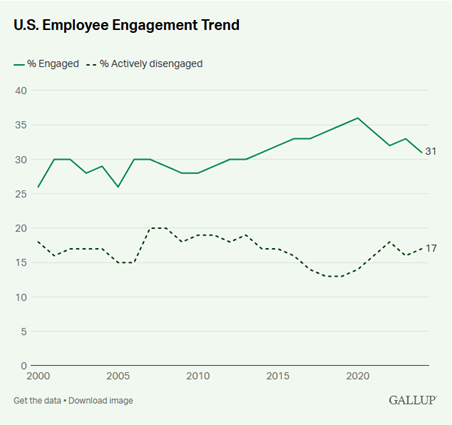
Many employee retention efforts, center on benefits and incentives for individuals and for the whole team. To keep people, we invest in their development, we provide great benefits packages, and we strive to help them see a version of their success that excites them. We give bonuses, we throw holiday parties, and company picnics. All good and all necessary. Although these can help promote engagement, their commonality limits their effectiveness.
In an insightful article for MIT Sloan, Catherine Bailey and Adrian Madden shared the findings from their study on meaningful work, where meaning comes from, and the mistakes managers make that can rob employees of meaning. Interestingly, the authors, in this study, found that the meaningfulness of work was not related to interactions with employers or managers. The factors were more intrinsic.
Based on their research and feedback from participants, they offered five qualities of meaningful work; one of which was reflection, unpacking what happened in the work, what was it about, who was it for, what was the big “why” of the work, etc. “Meaningfulness,” they write, “was rarely experienced in the moment, but rather in retrospect and on reflection when people were able to see their completed work and make connections between their achievements and a wider sense of life meaning.” Confirming a widely held notion that finding meaning in work comes from an inward place.
Knowing this, how can we optimize our people development systems (and by extension our organizational cultures) so that reflection is not only possible, but intentionally built into the system’s structure? Here are three practical ideas to start the exploration.
1 Create space and support for reflection.
The number one tool for reflective learning is time. It’s also the most elusive, so put it on the schedule. Consistency is key. One approach might be to have a 15 to 30 minute reflection time scheduled for the day. Then a one-hour reflection time at the end of the week to consolidate and review each day’s reflections, and a one-hour reflection at month’s end with someone (a coach or a leader) to dig deeper into any themes, observations, or opportunities that are discovered.
Consider providing notebooks or journals. The tactile nature of writing can sometimes help by slowing down the process and enhancing the act of remembering. Although, these could be held within a learning management system along with scheduling tools that help with reminders. Aim for a structured, but simple approach.
A place for reflection that is free from distractions and that promotes a meditative atmosphere is helpful. A quiet place to contemplate and rewind the day. Going to this place to reflect can help in the habit building stages as the learning culture takes root. Having an encouraging partner also helps. Coaches that understand how reflective learning works and how they can encourage this type of growth and development helps individuals by posing questions and guiding the thought processes so that these exercises remain focused and productive.
2 Build reflective learning into the PDS.
One of the guiding principles of the Optimized People Development System framework is becoming a learning organization. In such an organization, everyone engages in learning (including the leadership team) and each person should understand how this plays out for them. The theme of learning is supported by each of the five functional areas of the PDS.
Starting with the recruiting process, explain to potential employees how learning, reflective learning in particular, is part of the organization’s DNA. Set expectations and show them how this will happen. When onboarding, give them the tools for reflection and connect them to a coach. The training process can support how to become a reflective learner and then extends through to the performance management processes in the PDS. Retention efforts then incorporate these tools, times, and steps into conversations with leaders and coaches to ensure that the learner is tapping into those intrinsic forces that create meaning at work.
3 Learning leaders.
You’ve probably heard the well-worn research finding that 80% of the people who quit a job do so because of a boss or supervisor. Adding to this, Bailey and Madden found that the factors that contributed to feelings of meaninglessness were, in fact, driven by how people were treated by their leaders.
Robust and ongoing leadership development is vital to creating a culture of learning. There are many growth opportunities as highlighted in Bailey and Madden’s “Seven Deadly Sins” – a list of management behaviors that can drain the meaning from work. Each of these seven are behavior based and are indicative of leaders with underdeveloped emotional intelligence, who fail to understand the value of relationships, and who struggle to connect their behavior to the team’s success, among other things. Most of the root causes of these leadership behaviors can be addressed through training and coaching support.
One additional way to optimize leaders’ abilities in the context of the OPDS framework is to teach them how reflective learning can strengthen them and their teams. Encourage them to share their own reflective learning experiences with the team and to ensure that the tools and supports put in place for them are being used. Most importantly, guard the time for reflection selfishly. For themselves, and their team members.
The OPDS framework allows teams of leaders to experience their PDS as a complete system, together. In this manner, leaders learn to help each other avoid those destructive “Seven Deadly Sins” and help each PDS stakeholder see how they influence the success of the PDS. Time for reflection as a leadership team can identify ways to continuously improve this important system.
Reflection as a retention tool.
Finding meaning in the work we do is a personal journey. Some days the meaning is hard to find. Other days it seems to overwhelm. Without the time to reflect and remember, the journey can slip by in the busyness of the workplace and meaningful connections are lost. For the employee, a lost opportunity to learn. For the employer, a lost opportunity to create stickiness and engagement.
We ask a lot of leaders. They are guides, managers, problem solvers, and organizers. They are caretakers and decision makers. Leaders are also integral parts of several important organizational systems, and we ask them to make decisions and choices within the circumstances and contexts of those systems. Systems that are unique to each organization and behave in certain ways. Typically available, generalized leadership training may or may not add value if the systems that leaders belong to are not considered; or worse, are not fully understood.
According to Cambridge Dictionary online, a milieu encompasses the people, physical and social conditions, and events that provide the environment in which someone acts or lives. The leader’s milieu would necessarily include the way the organization recruits, trains, and seeks to retain people. This of course is what I refer to as the organization’s people development system or PDS. The leadership skills exercised in this particular system fall within these contexts – training, recruiting, onboarding, retention, performance management.
I’m most interested here in leadership at the frontline, in the trenches, and in the middle, not so much in the upper ranks. Although, they too work within a system that they should thoroughly understand. C Suite and upper management teams generally get most of the training and development though.
Obviously, a significant portion of what leaders do in front and middle operations is tied to their team’s performance. Meeting deadlines, producing results, and simply getting things done. Though much of this is managerial in nature, the way that leaders get things done requires that they use leadership skills like emotional intelligence and proper communication techniques.
There are many generic, widely taught leadership training courses available covering important subjects such as communication, emotional intelligence, delegation, etc. For these leaders-in-training an important consideration is, how are these matters generally handled in their current organizational systems?
Imagine that a newly promoted manager completes a workshop to improve their delegation skills. When, in fact, the people development system that they work within does not really focus on developing and training people. Nor does it have a well-defined and properly utilized performance management process. Delegating successfully in many regards becomes challenging in these system dynamics.
Perhaps the organization needs to expand its capabilities and wants to be more innovative. So, leaders are given some basic training and asked to lead the team in this new direction. Only, their PDS isn’t structured to promote a learning culture or foster creativity, so the training only frustrates the team.
What if the company’s leaders bring in a consultant to teach leaders how to be coaches, but the PDS doesn’t effectively facilitate relationship building? This would also be an important system consideration regarding more EQ training for leaders.
No doubt, leadership training is valuable. However, if these leaders do not understand the PDS they are a part of, or if this important system is not well run, the value that training could bring will be limited and will most likely fail to have the desired impact.
In conjunction with leadership training classes or workshops, the whole team should strive to understand how their internal workforce development efforts are designed and implemented.
What are the tools used across the PDS? What data is captured and analyzed to understand system performance? How well connected are the five functional areas of the PDS? How does communication across this system work? Among the most important considerations is how well each PDS stakeholder understands their role in the system.
The milieu of leadership is complex. And while training for leaders is important, it is also important to understand the system to which they and their team members belong. With this understanding they are more likely to be successful in all the important things that are asked of them.
Acceptance, embracing, agreement, endorsement…these are some of the synonyms of the word adoption. These words point toward a shift in thinking. However, when conversations about adopting technology happen in the manufacturing realm, the general meaning seems to always be related to application or implementation. The adoption of technology involves more than just getting a bunch of new machines though. Adopting tech has other important implications.
Manufacturing has embraced the use of technology for years. Known widely as Industry 4.0, a lot of the emphasis has been on robots, sensors, and data analytics. Though now, AI is quickly making its presence felt in this important sector too.
Typically, operations and production systems come to mind when considering how to apply technology in manufacturing. This is due in large part to the fact that engineers and tech pros tend to focus on the technology itself. The machines are cool. They do cool things.
Last year McKinsey & Co. conducted a survey around the use of AI . They found that employees are taking the initiative and learning about it and using it at an ever-increasing speed. More so than many of the organizations that employ them. Apparently much more.
This survey was aimed specifically at generative AI use across multiple industries. Obviously, in most industries, people will be impacted when technology solutions are deployed. The same is true for manufacturing. Maybe to a greater extent than in other industries.
For this reason, it is important to look past the shiny robots and the slick AI generated solutions to ask some very important questions. What about your people? How will technology change the culture of an organization? How will the organization need to change to take advantage of technology? What does becoming a tech savvy team actually look like?
McKinsey’s Relyea et al cautioned that, “Technology adoption for its own sake has never created value, which is also true with gen AI. Whether technology is itself the core strategy (for example, developing gen-AI-based products) or supports other business strategies, its deployment should link to value creation opportunities and measurable outcomes.” The people development strategy should certainly be included.
The report clearly makes the connection between deploying technology and preparing/supporting the teams that use the technology. This is where a higher level of tech savviness is needed.
In the future, being technologically savvy will mean more than just knowing how to create a prompt or program a robot. It will be more than just learning how the hardware and machinery works. It will also include thinking. How to think about technology. How to think with technology. Thinking about data and thinking about problem solving from a new angle.
It is more than just training savvy people to do certain technical things with automation. It will be about learning to imagine where technology can be placed, uncovering the data that can help determine whether the change has been successful, learning how to tap into the strengths of generative AI when it is appropriate, and learning to properly evaluate the answers and suggestions given by an AI assistant.
It will require tech savvy leaders learning how to coach their team to a higher level of tech savviness. Embracing new solutions influenced by technology as opposed to being rigidly connected to traditional ways of doing things.
The implications will stretch across the organization’s people development system as people learn to harness the full potential of technology. The culture of the organization will need to adapt to these new realities. Developing leaders will include helping to instill this new thinking paradigm. Learning organizations will thrive in this new environment.
Today employees are learning about and using AI on their own. They might be seriously trying to use it to make work easier and more efficient. Many may just be using it for entertainment. Recent studies have shown that they are also concerned about the impacts of automation, and they recognize that they must learn to work with these new tech tools. Technology has everyone’s attention.
Workplaces that help people attain a holistic understanding of technology can create and promote a culture of acceptance and endorsement of these new methods and tools. These workplaces can help people embrace technology in the workplace and perhaps understand how to use it constructively beyond their workplace. These types of workplaces can bring team members to an agreement that becoming technology savvy requires that everyone involved must learn to think and apply these concepts together.
Maps have long captured the imagination of countless generations. Whether in search of some fantastic treasure, some lost or forgotten land, or something more practical like finding the way home, maps have played a key role in human civilization. There are many types of maps helping to answer questions like, where are we now, and where are we going? What type of journey will this be, and how should we prepare?
These useful charts are for more than just simply changing physical locations though. Some maps can provide perspective and illuminate potential. Business leaders often use maps to identify improvement opportunities for their systems and processes. There are a few tried and true mapping tools that leaders have relied on for years in these efforts. Choosing the right tool is an important first step.
Lean manufacturing aficionados understand that details are important in pursuit of continuous improvement. The Value Stream Map has been used for years to visually represent all the steps involved in a process. The beauty of the VSM is its ability to show clear connections between process steps, information flows, and material flows.
However, there is a system where the traditional VSM is not the best map to allow a team to see the inner workings of a particularly important system. A system that could certainly benefit from continuous improvement efforts.
Introducing the Talent Stream Map
An organization’s internal workforce development efforts form a system, known by my team as their People Development System. It is comprised by five functional areas – recruiting, onboarding, retention, performance management, and the heart of the system, the training process.
The PDS is a complex, non-linear system. Its functions and activities occur at various times, with multiple stakeholders, in many places across the organization. For example, retention efforts on second shift, multiple training activities on all shifts, and a conversation over lunch regarding performance improvement opportunities. And, of course, the PDS does not produce a “finished” product. People should always be receiving training and getting performance management support. Retention efforts are also never ending.
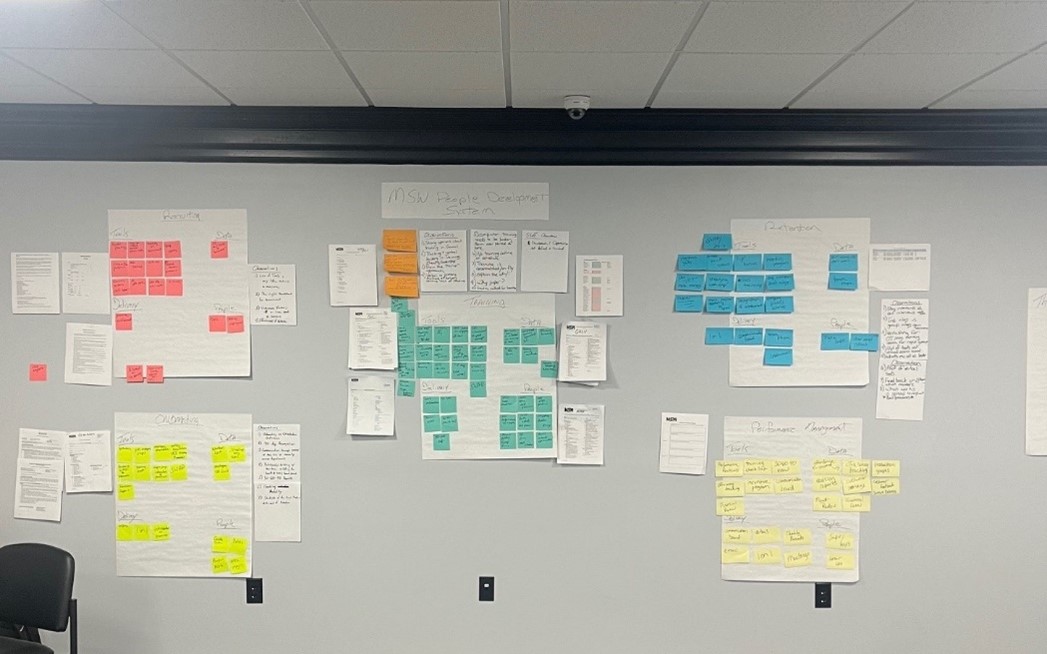
Recognizing the need to help provide visibility to the structure and functions of the PDS and inspired by the Value Stream Map, my team developed the Talent Stream Map, a visual guide of all the components necessary to find, train, and retain people to help an organization meet its strategic goals.
The structure of the TSM
Four drivers
The PDS is empowered and energized by the tools used, data collected, methods of delivery, and the people involved in the processes it houses. Once identified, these components are seen side by side and gaps and opportunities can be explored.
Mapping the tools used in all the processes of the PDS allows the exploration of several helpful questions that can guide the discovery of improvement ideas. For example,
Do we have all the tools needed?
When was the last time tools were updated?
Are we using tools like development pathways effectively across the PDS?
Are we leveraging the tools from one area to another across the whole PDS?
Data is generally collected to help manage the PDS, if only at the basic level, which is fairly easy to track down. Comparing data across the whole of the PDS isn’t as simple. Gathering better data can inform better decisions. When mapped, gaps and opportunities for data collection become more obvious.
What data are we getting and are we actually using it?
What data is missing?
What correlations can be made from data across the five functional areas?
Are we asking the right questions of the data?
Exploring the delivery of the process steps and services helps stakeholders to evaluate the effectiveness of the delivery and to identify potential improvements.
Are the methods of delivery up to date? (this relates to things like technology and to people’s expectations, etc.)
Is the timing of delivery right?
Where are we delivering these steps and services?
How can we improve the delivery?
The people component of the PDS is one of the most important, and one of the most challenging to see. Leaders at all levels contribute to the PDS’s success or failure. Undoubtedly, frontline managers & supervisors impact the process of finding, training, and retaining employees. They are the main avenue of communication within the PDS – their influence even reaches the community. These important stakeholders impact culture, either positively or negatively.
Are the people involved in the PDS aware of their roles?
Are they trained to do their part (in each of the five areas)?
Are they held accountable for the success of the PDS?
How can we help people improve in their PDS related roles?
Once the mapping effort has revealed who is involved with each area and how they are involved, those leaders and stakeholders can visually see how they fit into the system and understand how and why their contributions matter.
The purpose of the TSM
To begin to improve a system, you must first establish its condition. The TSM is intended to make a complex, people-centric system more visible to identify gaps and opportunities that might go unseen otherwise.
After the current state is established and understood, the next logical step is to begin to construct a future state map. This is where the strategy development starts. Stakeholders can make observations, express ideas and concerns, and begin the process of envisioning what the system could potentially look like.
The value of the TSM
Ideally, the TSM is built by all the stakeholders of the PDS. Those being all the individuals who supervise or manage others. As the process unfolds, stakeholders will see parts of the PDS that they may not have seen or fully understood before. There will be conversations that could reveal a misunderstanding of how certain functions are supposed to work versus how they actually work. Ideas, assumptions, and concerns can be voiced. Most importantly, mental models can be aligned, or the recognition of the various mental models can be dealt with.
Waste reduction is the defining hallmark of lean thinking. The TSM helps teams isolate and reduce waste in the people development system. Waste in this system differs from waste in the traditional lean definition. Time, effort, and money are the main types of waste in the PDS, but there are also intangible wastes such as wasted opportunities and wasted potential.
Using the TSM
Making the complexities of the internal workforce development efforts visible can help teams in a number of ways.
Awareness. All stakeholders get a wholistic view of the system and their role within it.
Discovery. Identify gaps and opportunities across one of the most important organizational systems.
Dialog. One of the most valuable aspects of using the TSM is the conversations that occur during the map’s construction.
Business leaders are weary of trying to solve the labor issues we are facing in our state and across the country. The Optimized People Development System and the Talent Stream Map were developed to help these leaders identify often unseen levers that they might manipulate to improve their methods to find, train, and retain the people they desperately need. They help leaders focus more on the things they can control and less on the things they cannot.
The right map can make a journey more successful. The Talent Stream Map helps identify the “You are here” point in a journey toward improving your people development system. It serves as a great guide along the way, and it engages all the system stakeholders as they can make this improvement journey together.
If you would like more information about either of these tools let us know. You can reach me through the comments here or at tim.waldo@tennessee.edu.
Do us a favor please. If you construct a Talent Stream Map with your fellow stakeholders, please send us pictures and share your story. We love to learn how teams use these tools to improve their people development efforts.
The heavy cloud of concern over the American labor force continues to weigh down employers. Frustrated and exasperated leaders at all levels are struggling daily with the difficulty of finding and keeping people. My team at the Tennessee Manufacturing Extension Partnership certainly hears the frustration from those we serve.
Driven by tenacity and a pressing sense of urgency, more business leaders are looking outwardly and investing in long-term solutions with multiple partners while ramping up efforts to attract people to work now. Investing some of that valuable time and effort inwardly could also help address the challenges of finding and keeping a stable workforce.
Look again.
Many manufacturers in Tennessee have already taken a close look at their people development efforts. Some have revisited their policies, some have expanded their benefits, and others have bolstered training and development. Still, there are probably other improvements to be made. In the spirit of continuous improvement, there’s always a chance to dig deeper and uncover new efficiencies and opportunities.
The Optimized People Development System suggests that a good starting place is to create a Talent Stream Map. Based on the value stream map used in lean thinking, the Talent Stream map makes the PDS visible with all its beauty and wonder right alongside all its warts and freckles. Once all the stakeholders have their say and the TS map is complete, it becomes easier to explore possibilities for improvement.
Look deeper.
Asking more questions at more levels of the PDS can reveal overlooked opportunities. How can we improve recruiting is a good question. Can we expand where we recruit is also a good question. How are we attracting potential team members and when does attracting turn into recruiting? Can we do that part better? Digging into why we are recruiting will almost certainly stimulate some interesting discussions that cause other parts of the PDS to be reexamined.
Another good question is, how are our retention efforts? What if we explore how we are personalizing retention? When do we begin our retention efforts in earnest? How can we do that part better? There are many questions that will come from looking more intently at all five areas of the PDS. Challenge the system stakeholders to stretch their question asking skills.
Applying continuous improvement means to constantly ask more questions and explore more possibilities to make things better. If the organization has a good or even a very good people development system, there are surely other improvements that can still be made. Better questions help us to find those hidden opportunities.
Hidden in plain sight.
As the team explores the PDS, they often find things that were obvious, but unnoticed. In one instance, as a group of stakeholders stood in front of their TS map and discussed the flow of communication, they discovered that one tool they were using was not working as designed. They saw this after several questions about how the tool was supposed to be used and when. It was being used, but not consistently and not in the same way by all departments. They suddenly had a meaningful way to improve one of their processes.
Stakeholders of another system unearthed persistent inconsistencies across departments regarding how training was being delivered and even what training was available. Eight supervisors described how they individually understood the company’s training approach, and ultimately discovered that they all had a different understanding of that extremely important aspect of people development.
It has never been tougher to find people to help an organization fulfill its goals and purposes. Looking at and engaging with outward workforce development efforts to ease the struggle is important. However, overlooked improvements in the organization’s internal processes could also help fill positions and keep them filled.
Discovery of these opportunities comes from thoughtful, purposeful exploration at all levels of the PDS and a willingness to dig deeper. Even though you’ve looked already, look again. Go another layer or two in. There just might be overlooked opportunities that could help reduce the amount of frustration and helplessness that your team is dealing with.
They are usually abandoned gradually, though unintentionally. They live on determination, but when discipline fades, these are among the first attributes to disappear. Ironically, growth and success often cause them to be compromised and quietly forgotten. They are the fundamentals, the essential, bedrock practices so vital for success.
It’s been said that fundamentals win championships. Look up almost any famous athlete and they often point to their mastery of the fundamentals as the main driver of their success. The concept applies to organizational habits as well; especially when it comes to developing and keeping a strong workforce.
“Ladies and gentlemen, this is a human being.”
Football is a complex game. When coach Vince Lombardi embarked on a journey to build a championship team, he went all the way back to the most basic concept. He reintroduced his 1961 team to the football, not to a strategy, to some new rules, or to new ways to play the game, but to the ball itself. He refocused their attention on the most basic of the basics. A detail easily taken for granted. This article from James Clear discusses the impact of Lombardi’s simple idea.
At its most basic level, an optimized people development system is about people. Its role is to serve people well, treat them well, and keep them well. To do this, the system must value relationships and foster effective communication. Appreciating the whole person and committing to their development and growth are basic principles for an effective PDS. But it’s easy to lose sight of the basics.
Fast-paced workplaces busy trying to remain competitive and satisfy customers, can let important practices drift, and begin to assume that the basics are somehow happening. Surely everyone knows that the organization values people, right? A detail easily obscured by daily pressures.
If your PDS seems to have lost something, has grown weak, or worse, has never been strong, perhaps there’s a need to revisit the fundamentals. Was there a time when the PDS was more focused on people? When the basics of valuing every individual were much more prevalent? Has the system crept away from this basic tenant?
Of Great Consequence.
Merriam Webster.com offers another nuanced meaning of fundamental, “It applies to something that is a foundation without which an entire system or complex whole would collapse.” The role of the PDS is fundamentally important.
This system supports all other organizational systems. Practically every organizational system requires people (sounds basic, doesn’t it?). If those people who operate all the organization’s systems are unhappy, underdeveloped, or undervalued, there can be serious consequences. However, when systems are difficult to see (as the PDS is), it is easy to forget how important they really are.
In practice, this means that leaders and stakeholders of the PDS must constantly assign high levels of importance to the PDS and be disciplined about maintaining this focus. Previous posts on this blog explore this idea in more detail.
Avoid a Slow Surrender.
Mahatma Gandhi once said, “All compromise is based on give and take, but there can be no give and take on fundamentals. Any compromise on mere fundamentals is a surrender. For it is all give and no take.”
Abandoning the fundamentals that empower an organization’s people development system is a slow surrender. It starts when the stakeholders fail to value relationships. When they forget that treating people with dignity and respect is non-negotiable, when they fail to encourage their people to learn and grow, they give up future potential and miss the opportunity to deepen engagement. Communication weakens and powerful components of success slowly disappear.
When the perceived importance of the PDS diminishes, training gets pushed off and staff development sees little or no investment. When leaders take the PDS for granted, they can inadvertently compromise the organization’s vision.
Modern methods for finding, training, and retaining people are very complex. In the spirit of Vince Lombardi, leaders should ensure that the basic practices that support their people development system are not lost in the melee. In addition, they should strive to constantly highlight the importance of the system to the organization’s goals.
To keep the fundamentals at the forefront of the organization’s collective mindset takes discipline and determination. Champions pay attention to the fundamentals. They commit themselves to them and practice them consistently. Building a championship-caliber people development system requires the same level of commitment.
How do you move a team? An organization? Not so much in the physical sense but in the sense of motivation. How do you move people toward change? Setting the vision for their team is one of the more important tasks leaders have. Theirs is the challenge of identifying those key aspects or that most influential of things that will have a positive, lasting impact and ultimately help the team achieve its goals. Sometimes the best options for exerting the forces necessary for that movement are not so obvious, even to the people deeply entrenched within the organization’s systems.
The Lever
Leverage points, for leaders, are those opportunities that can exert force against the norms. A very powerful lever was identified at the world’s largest aluminum company in 1987.
In The Power of Habits, Charles Duhigg recounts The Ballad of Paul O’Neal. It’s the story of when O’Neal, an unconventional choice for the role, took over as CEO of Alcoa and informed shareholders that to turn the ailing company around; he intended to focus on one key aspect – safety – not profits, not investments, not acquisitions, or growth. The goal was zero safety issues across the whole company. Duhigg describes the reaction of the shareholders (and his own reaction) as something of a stampede for the exits. Most thought O’Neal had lost his mind.
The lever he chose was of common interest for everyone concerned with the organization. Ultimately, O’Neal’s safety program leveraged this common bond to improve morale and engagement, increase innovation, and drive quality.
Even before accepting the job, O’Neal searched for something that would “transform the company.” Safety was not the big, shiny lever. Nor was it the most widely accepted lever. It was, however, the company-wide habit that influenced a host of other habits across the organization. Change this one thing, and several other dominoes would fall. And fall they did. Profits hit record highs, net income rose, and market capitalization soared.
O’Neal’s reasoning fits easily into Duhigg’s observation that “Keystone habits say that success doesn’t depend on getting every single thing right, but instead relies on identifying a few key priorities and fashioning them into powerful levers” (p. 101).
The Fulcrum
If O’Neal surmised that the keystone habit of safety was the lever, he also understood that systems thinking was the fulcrum on which it operated. Their system was broken. It wasn’t living up to anyone’s expectations. Remarkably, as the force exerted by the new focus on safety rippled through the organization, feedback loops began to send different signals and internal connections began to alter and improve.
Changing this one keystone habit did, in fact transform Alcoa, moving it to a much stronger position foundationally and fiscally. The complex collection of systems known as the Alcoa Corporation began to move toward its shared vision.
Systems thinking urges us to consider the far-reaching impacts that levers might have if and when they are pulled. Peter Senge said, “Vision without systems thinking ends up painting lovely pictures of the future with no deep understanding of the forces that must be mastered to move from here to there” (p. 12).
Paul O’Neal helped his team gain an understanding of the forces they had to master to reach their vision. He did this by identifying a less obvious point of leverage that had the greatest potential to impact the whole system.
The search for those less obvious, impactful levers is not always easy. Leaders have to learn to look deeper and wider. It isn’t enough to be a visionary leader. It requires learning to see relationships, understand connections, and to follow the important system patterns where some powerful levers of influence quietly wait to be discovered.
References
Duhigg, C. (2012). The power of habit: Why we do what we do in life and business. Random House, NY.
Senge, P. M. (1990). The fifth discipline: The art and practice of the learning organization. Doubleday, NY.