Tag: workforce development

  • Can Your System Achieve Employee Engagement?

    Can Your System Achieve Employee Engagement?

    For over a quarter of a century employee engagement has been dismal. Difficulty in defining the concept has had a lot to do with this stagnation. However, a shared vision of a truly engaged workplace by all stakeholders is possible with an attentive people development system. A PDS intent upon moving the needle on this stubborn but important metric.

    When the phrase appears, employee engagement generally implies that an individual has a deep level of commitment, a strong willingness to be involved, or a high degree of dedication to being a part of the team and excelling at their work. The word excitement often shows up in the definition, sometimes the word motivation, and happiness might also appear.

    Some explanations seem to border on the concept of achieving a state of mental flow, suggesting that engagement is being fully absorbed by and enthusiastic about the job. Some days, yeah. Some days, no. Several people that I’ve worked with in the past who were very much bought into the success of the company could seldom be described in these terms. Nevertheless, they understood their connection and responsibility to the team, and they did, on a regular basis, contribute a great deal.

    It’s a complicated concept; one that has changed over the years. Tony Martignetti and Moe Carrick, business leaders and authors, compellingly argue that employee engagement is being replaced by a sense of employee connectedness. Pointing out that the move toward connectedness has been driven by social and cultural forces that have obvious impacts in the workplace.

    Along those lines, I prefer to think of employee engagement as a mutually beneficial harmony reached when both employer and employee recognize and accept their responsibility for the success and well-being of the other. It takes all parties to achieve this harmony, and it takes a responsive PDS to promote and protect it.

    A Shared Understanding.

    Since all stakeholders have a vested interest in this, it seems like a good idea to start by understanding employee engagement very clearly. And though it sounds simplistic, getting all PDS stakeholders on the same page is a good first step in building stronger allegiances.

    It is talked about so much in certain circles that it can lead to assumptions that everyone knows what engagement is and how it matters, which is obviously not the case. Getting everyone’s mental models of this vital connection out in the open and agreeing upon a unifying model can reduce misunderstandings and misinterpretations of the concept.

    Leaders of organizations, just like individual workers, have the right to think about engagement what they will and to have certain expectations about what it takes to achieve this state of harmony. There may be very little distance between the two ideals, or there could be a chasm. Alignment of expectations and agreement around everyone’s responsibilities could mean the difference between dismal performance for another quarter century and levels of engagement that are truly beneficial for all.

    How Far Apart are We?

    One of the primary roles of the PDS is culture building. An engaging culture connects people, shares openly, clarifies goals, promotes learning, and ensures that stakeholders share responsibility for outcomes.

    An optimized PDS helps create space for dialog and allows the whole team to debate the definition of engagement and agree on ways to improve it. This falls easily under the training and development function of the system.

    Start by creating small cross functional teams and share the data – turnover, average tenure, survey results, etc. Let the team know how these numbers impact both the organization and every individual within it. Then ask the teams to help improve the numbers. Everyone benefits when these indicators improve and self-interest is a powerful motivator.

    Part of the retention efforts of the PDS should be to bring senior leaders into community with frontline workers through one-on-one coffee breaks, lunches, or small group brainstorming sessions. These are perfect times to bring up the topic of engagement. Ask questions about engagement, extend the dialog created in the cross functional groups. Discuss the roles that each stakeholder plays and then help them play those roles well.

    These interactions are also great opportunities to further explain how being engaged is in everyone’s best interest. Thanks to the proverbial grapevine, these conversations will find their way back to the entire team. Done well, this can feed into other positive conversations, helping to drive higher levels of commitment.

    Of course, this means that the leaders must be educated on those impacts and trained in having these coaching/development conversations. Another job for the optimized PDS! To be effective, leaders must understand how important employee engagement really is and how they impact it.

    Measure it…But Differently.

    Employee engagement is usually measured via a survey asking people about their state of mind at a particular time. Which can skew the results dramatically, depending upon moods, circumstances, and other life situations.

    Instead, look for and measure individual behaviors that tend to be driven by a higher level of buy-in or consensus. These might include:

    • Number of teams/groups individuals have joined,
    • Number of requests individuals make for development opportunities,
    • Levels of development attained (individual development plans are great for tracking this!),
    • Number of ideas generated per individual,
    • Involvement in and contributions to events (improvement events, community-facing events, peer support events, etc.),
    • Relationships developed (social connections with co-workers, coaching, etc.),
    • Willingness to be part of initiatives,
    • Changes in attendance patterns,
    • Personalization of workspace.

    Keep doing engagement surveys, one on one encounters, and peer evaluations to assess the harmony. Even better, be creative in identifying other more meaningful metrics, realizing that being engaged influences several behavioral and personal performance indicators. Share these measures liberally with the team, encouraging them to value these outcomes.

    Old Systems Will Struggle.

    According to Martignetti and Carrick, “To build connected organizations, leaders must shift from driving engagement to designing relational ecosystems and from motivating individuals to strengthening networks.” Here’s a pressing question; can the organization’s internal people development system support this shift in thinking?

    Look more closely at the system level for opportunities that can move the conversation in the right direction. Systems thinking is one of the three guiding principles of the Optimized People Development System framework because the PDS is a dynamic system and difficult to see. It is also the most important organizational system for fostering connections and relationships.

    Employee engagement has languished far too long. Establishing a shared definition and innovative measures of employee commitment and their wellbeing can help move the numbers in the right direction. An optimized PDS, one that fosters a new mindset around engagement and connection can help keep that movement going.

    Image by Gerd Altmann from Pixabay 

  • Time to Challenge the One-Sided Employee Engagement Push

    Time to Challenge the One-Sided Employee Engagement Push

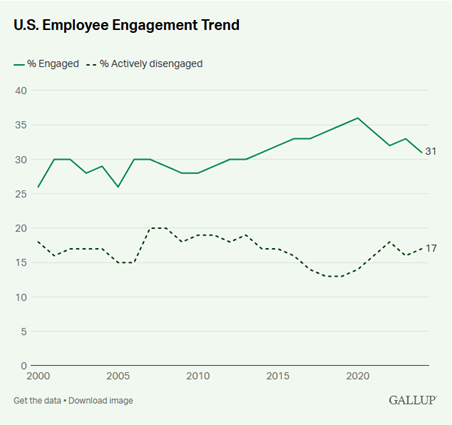
    Stickiness hasn’t changed in the last quarter of a century. According to Gallup’s long running, annual surveys, employee engagement has remained around 30% and active disengagement around 17% since Y2K was a thing. Gallup’s surveys and others confirm that getting people to consistently participate at a higher level desperately needs to be improved.

    Employee engagement is a prime area where improvement can benefit everyone. People are frustrated. Money and productivity are being lost due to low engagement and the negative impacts of a disengaged workforce show up at multiple levels beyond just the workplace.

    Why haven’t we been able to move the needle on the levels of engagement? It’s not like we haven’t been trying. I, and many of my workforce development peers, have been preaching to employers for years the need to create an engaging workplace. And most have been sincere in their attempts to do this demanding work. Still, we hear very regularly that these same employers are struggling to find people who want to work, people who will stick around long enough to see the benefits and advantages of being on the team. Some, including the MikeroweWORKSFoundation, have lamented the loss of the will to work. Maybe we’ve been focusing too much on only one side of the equation.

    Limits to an Engaging System

    Each team member is a system, just as the organization is a system. When these two systems are integrated, both are impacted. So, the probability of success by the organization in building an engaging environment will be limited if the newly integrated systems do not share a common goal around, or even a unifying understanding of the purpose and value of work. If the individual system is unaware of how to engage, unable to engage, or unwilling to engage, how successful can the organizational system’s attempts at engagement be?

    Focus on the Other Part of the Equation

    Here’s a potentially controversial solution – let’s help individual team members appreciate the many values of work and why engaging at work is in their best interest. There are distinct and powerful reasons for individuals to pursue being engaged at work.

    Beyond the obvious economic benefits, work is good for the health – physical, mental, and yes, spiritual health. A good day’s work influences positive feelings toward life. Workplace stress is well documented. How much of this might be relieved with a healthier view of work? Family life benefits when things are good at work. A different mindset about work could help promote this.

    Work is an integral part of the human experience. Always has been, always will be. But it goes beyond just the part of work we get paid for. The theme of work runs all the way through the Christian scriptures starting with the first verse of Genesis. I’m no religious scholar, but a cursory search indicates that work is pretty prominent in many other belief systems as well. We need to help people take a holistic view of work. The whole person comes to the job, so the whole person should be taken into consideration, including the spiritual side.

    Other Benefits

    In future posts we’ll unpack some more details of the benefits and values of work. Looking at the definition of engagement is helpful. So too the way we measure it. Engagement at work is very much an emotional reaction. How do we feel about the work, the people, the mission, and vision of the organization? It is emotionally intelligent for everyone to engage at work. How might we bring EQ into the solution to this challenge? Other topics might find their way in as well. Your thoughts and insights could add immeasurably to this exploration, so I invite you to opine as we explore.

    For years we have, in my opinion, pushed employee engagement mostly from the employers’ side of the equation. Certainly, there is still work to be done by employers; however, the other stakeholders must also take responsibility and do their part to engage and be engaged.

    An Optimized People Development System can be a strong vehicle for change in this effort. Examining the concept of engagement while looking closely at the internal system we depend upon to find, train, and retain people can offer strategic opportunities for improvement. Improvements to the system and the philosophy under which it operates could certainly help the organization and each individual within it, stick together longer over a shared appreciation for the true scope and amazing values of work.

    Image by Mohamed Hassan from Pixabay

  • Patience is a Virtue, and Soon, a Crucial Leadership Skill

    Patience is a Virtue, and Soon, a Crucial Leadership Skill

    It’s ironic that a technology that drastically speeds things up will require people to slow down in many areas of their work. Leaders in the AI era will have to develop something that we’re not typically known for…patience. In a sped-up world, the ability to play the long game will be a needed leadership trait.

    This Fast Company article is a great read for leaders, highlighting the need for different ways of thinking in the fast paced world of artificial intelligence. This new approach to leadership will also require ways of measuring certain outcomes differently. Outcomes that may take some time to materialize.

    Most business leaders have been conditioned to chase short term measures – this week’s production numbers, this month’s sales, this quarter’s financials. Generations of managers have been trained this way, and this has filtered down and out across the workforce.

    McDearmid captures the frenetic tension quite well. “For years, we filled our calendars, stayed visible, and kept the machine moving. Our worth was measured in hours, output, and presence. It had to be. Humans were the system, and the system required us to keep it running. We didn’t question it because that was how things got done.”

    The repetitive stuff was the work, and the measures by which the work would be gauged. Fueled by numbers relatively easy to get, requiring minimal patience. However, the human work of curiosity, collaboration, and changing mental models can be slow to unfold. Exploration can take time. Intentionality too.

    The article describes the directional change that leaders will need to make. How their focus must change from tasks to direction setting, seeking clarity for the initiative, and clarifying vision with the team, to name a few. It also points to the fact that leaders will need to be able to think differently about how long it will take to see some important deliverables.

    “AI has taken the repetitive pieces off our plates and has given us back the chance to think, create, and build with intention. It gives us room to lead.” In this new, redesigned space for leadership the ability to ponder and contemplate could be useful skills. Leaders with imagination and a gardener’s mindset will have an advantage. Systems thinking will be highly prized. Because ushering slow moving change through a system previously built for speed will require a shift at the system level.

    It may seem counterintuitive to work on the skill of slowing down in a sped-up world. However, learning to wait calmly for important and often subtle changes is a skill that itself takes time to develop. The sooner we start training leaders to slow down and wait, the faster we can realize the advantages of AI.

    Image by Annette from Pixabay

  • The Same Kind of Same as Me

    The Same Kind of Same as Me

    Ever see yourself in the reflection of another generation? This sometimes happens to me when I see a survey about the differences between the age groups. Recently I saw one by ResumeTemplates.com on Gen Z workers.

    I am not from Gen Z. Along with everyone else though, I have been placed within an age group, one that has progressed through life with all kinds of expectations. But I have chosen the ones that I value. Experiences and circumstances have shaped all parts of my life. And I have adapted to what life has presented. The generation that raised mine was motivated by a few different things, some of which I rejected. And I now understand that everyone from any generation can claim these statements as their very own.

    Actually, we’re not all that different

    I don’t see anything in this particular survey that I could point to as something my cohort didn’t do at some level. A few yelled at the boss. A few cried at work. Most of us complained about the boss, been unprofessional, etc., etc. Maybe the percentages were different.

    A quick search will proffer many surveys over the years comparing Boomers to Gen X, Gen X to Millennials, and Millennials to Zs. Seems like they all focus on the differences and try to explain the reasons for those differences, justify the changes in attitudes, or rationalize the shifts in behavior.

    Surveys help us take a pulse of how things are going and how people feel, but they also tend to feed a narrative that can make people believe that the generations before and after them are somehow unique. Often, they cater to confirmation bias, confirming that something is dreadfully wrong with that bunch!

    Been there, done that

    On occasion though, observations drawn from these studies do more to show the similarities between generations. “Gen Z doesn’t need to suppress who they are,” says Chief Career Strategist Julia Toothacre. “But learning to read the room and adjust accordingly is what builds long-term credibility.” Yep, we had to learn this lesson too. Every generation has. Perhaps we could help each other?

    It could be beneficial and constructive if we focus less on our differences and try harder to recognize similarities and learn from each other. Someone should do a survey that asks, “How many similarities are there between this generation and those others?” Surely, it’s been done before. If so, please share. I’d love to see them.

    An opportunity for the PDS

    Comparisons are a thing, as we’ve seen, and since this is a blog about workforce development, here are four ideas to optimize your people development system to help generations take advantage of their similarities and their shared values.

    1. Avoid highlighting differences! We would certainly benefit from identifying as one team with diverse gifts and levels of wisdom instead of saying things like, “We have four generations on our team and we’re all different!”

    2. Intentional team building. Activities that bring generations together in cross-generational, cross-functional teams connecting different perspectives in the spirit of solving problems and learning from each other.

    3. Bridge the divide with coaching. Train up some coaches on this specific topic and turn them loose within the team. Ideally, you’ll have coaches from all generations!

    4. Communicate. Ensure that everyone on the team understands that the goal is to identify and capitalize on commonalities and similarities across the whole team.

    The divide between generations is largely a self-inflicted malady. An optimized people development system can go a long way in providing a cure and building bridges to connect all ages represented on your team.

    PS…Props to the movie Same Kind of Different as Me. It’s about seeing the value and purpose in other people. Check it out.

    Image by Gerd Altmann from Pixabay

  • Gen Z Thinks Differently, 3 Ways Your PDS can Still Get Their Attention

    Gen Z Thinks Differently, 3 Ways Your PDS can Still Get Their Attention

    Your system is open. Your people development system that is. Being an open system means that it is influenced by and therefore obliged to react to outside signals and influences. Some of those powerful influences include the mindset and motivations of generations of workers.

    Randstad asked some Gen Z technology workers about their work preferences, finding some differences and a few similarities with other generations. Fortunately, the feedback provides useful insights for all employers as they consider how modern people development systems might need to evolve in the future.

    This next generation of workers has different values, different ideas about work, and, like every generation before and after, will be needed in the workplace. Which means that the systems used to find, train, and retain them must adapt or at the very least, find some way to accommodate.

    Knowing that these young workers are thinking about life and work differently, here are three ways to optimize your PDS to tap into their potential.

    A grain of salt.

    Don’t paint the entire generation with the same brush. There will be those that like to work with their hands, those that prefer to be in community with other workers, and those that are inclined to stay longer than a couple of years. Influences from other generations will still be seen in younger workers.

    Optimize your people development system to tailor job postings that speak to them, job descriptions that inspire them, and recruiting methods that communicate clearly. Work on finding those outliers, they are out there.

    Focus on growth.

    The desire to learn and grow is not exclusive to this generation. What is different about their approach to work is their willingness to move quickly if they perceive that growth is limited. This is borne out again in Randstad’s survey results.

    Reenforce PDS tools such as personalized development pathways and career ladders to communicate opportunities early and often. Augment these tools with strong onboarding practices, robust training initiatives, and focused performance management efforts.

    Lean into technology adoption.

    Gen Z has never known life without technology. They expect the workplace to maximize automation and all things AI. Industry and the marketplace are also driving adoption of technology, so the PDS has to do the same.

    The optimized PDS will ensure that technology is used across all five of the functional areas of the system that supports all generations of workers. A workplace that utilizes generative AI and agentic AI will have a PDS that not only uses AI tools, but will teach people how to think about technology, how to think with technology, and how to use it safely and effectively. Outside influences are powerful forces that challenge PDS stakeholders to adjust and adapt. The system itself will need to change to attract and retain talented workers in Gen Z.

    Image by Franz P. Sauerteig from Pixabay

  • Want Your Employees to Stay? Three Ways to Help Them Unpack

    Want Your Employees to Stay? Three Ways to Help Them Unpack

    You start trying to keep them even before you get them. This idea that efforts to retain employees should start in the recruitment process often surprises some stakeholders of an organization’s people development system. Retaining good employees is a long journey and like any journey, a time of reflection can add meaning to life and cement the impactful parts. In fact, reflection might well be one of the most powerful yet often overlooked ways to inspire people to stay.

    Many employee retention efforts, center on benefits and incentives for individuals and for the whole team. To keep people, we invest in their development, we provide great benefits packages, and we strive to help them see a version of their success that excites them. We give bonuses, we throw holiday parties, and company picnics. All good and all necessary. Although these can help promote engagement, their commonality limits their effectiveness.

    In an insightful article for MIT Sloan, Catherine Bailey and Adrian Madden shared the findings from their study on meaningful work, where meaning comes from, and the mistakes managers make that can rob employees of meaning. Interestingly, the authors, in this study, found that the meaningfulness of work was not related to interactions with employers or managers. The factors were more intrinsic.

    Based on their research and feedback from participants, they offered five qualities of meaningful work; one of which was reflection, unpacking what happened in the work, what was it about, who was it for, what was the big “why” of the work, etc. “Meaningfulness,” they write, “was rarely experienced in the moment, but rather in retrospect and on reflection when people were able to see their completed work and make connections between their achievements and a wider sense of life meaning.” Confirming a widely held notion that finding meaning in work comes from an inward place.

    Knowing this, how can we optimize our people development systems (and by extension our organizational cultures) so that reflection is not only possible, but intentionally built into the system’s structure? Here are three practical ideas to start the exploration.

    1 Create space and support for reflection.

    The number one tool for reflective learning is time. It’s also the most elusive, so put it on the schedule. Consistency is key. One approach might be to have a 15 to 30 minute reflection time scheduled for the day. Then a one-hour reflection time at the end of the week to consolidate and review each day’s reflections, and a one-hour reflection at month’s end with someone (a coach or a leader) to dig deeper into any themes, observations, or opportunities that are discovered.

    Consider providing notebooks or journals. The tactile nature of writing can sometimes help by slowing down the process and enhancing the act of remembering. Although, these could be held within a learning management system along with scheduling tools that help with reminders. Aim for a structured, but simple approach.

    A place for reflection that is free from distractions and that promotes a meditative atmosphere is helpful. A quiet place to contemplate and rewind the day. Going to this place to reflect can help in the habit building stages as the learning culture takes root. Having an encouraging partner also helps. Coaches that understand how reflective learning works and how they can encourage this type of growth and development helps individuals by posing questions and guiding the thought processes so that these exercises remain focused and productive.

    2 Build reflective learning into the PDS.

    One of the guiding principles of the Optimized People Development System framework is becoming a learning organization. In such an organization, everyone engages in learning (including the leadership team) and each person should understand how this plays out for them. The theme of learning is supported by each of the five functional areas of the PDS.

    Starting with the recruiting process, explain to potential employees how learning, reflective learning in particular, is part of the organization’s DNA. Set expectations and show them how this will happen. When onboarding, give them the tools for reflection and connect them to a coach. The training process can support how to become a reflective learner and then extends through to the performance management processes in the PDS. Retention efforts then incorporate these tools, times, and steps into conversations with leaders and coaches to ensure that the learner is tapping into those intrinsic forces that create meaning at work.

    3 Learning leaders.

    You’ve probably heard the well-worn research finding that 80% of the people who quit a job do so because of a boss or supervisor. Adding to this, Bailey and Madden found that the factors that contributed to feelings of meaninglessness were, in fact, driven by how people were treated by their leaders.

    Robust and ongoing leadership development is vital to creating a culture of learning. There are many growth opportunities as highlighted in Bailey and Madden’s “Seven Deadly Sins” – a list of management behaviors that can drain the meaning from work. Each of these seven are behavior based and are indicative of leaders with underdeveloped emotional intelligence, who fail to understand the value of relationships, and who struggle to connect their behavior to the team’s success, among other things. Most of the root causes of these leadership behaviors can be addressed through training and coaching support.

    One additional way to optimize leaders’ abilities in the context of the OPDS framework is to teach them how reflective learning can strengthen them and their teams. Encourage them to share their own reflective learning experiences with the team and to ensure that the tools and supports put in place for them are being used. Most importantly, guard the time for reflection selfishly. For themselves, and their team members.

    The OPDS framework allows teams of leaders to experience their PDS as a complete system, together. In this manner, leaders learn to help each other avoid those destructive “Seven Deadly Sins” and help each PDS stakeholder see how they influence the success of the PDS. Time for reflection as a leadership team can identify ways to continuously improve this important system.

    Reflection as a retention tool.

    Finding meaning in the work we do is a personal journey. Some days the meaning is hard to find. Other days it seems to overwhelm. Without the time to reflect and remember, the journey can slip by in the busyness of the workplace and meaningful connections are lost. For the employee, a lost opportunity to learn. For the employer, a lost opportunity to create stickiness and engagement.

    Image by Pexels from Pixabay

  • People Centric Workplaces

    A strong people development system within any workplace exists among other systems. Here’s an article I recently wrote as part of a University of Tennessee initiative that underscores the importance of seeing these systems within systems. The impacts are far-reaching.

  • The Missing Part of an Optimized Workplace

    The Missing Part of an Optimized Workplace

    I have been unfair to the organizations I serve. As an advisor and advocate for workforce and workplace development, I have been telling employers for years that they must build great workplaces to attract and retain the talent they need. I have implored them to create people-centered workplaces. I have shown them study after study that insists that without efforts to create great cultures, to make their people feel appreciated, and to ensure that they are investing in the development of their teams, they could expect a lifetime of crippling instability in their workforce. But I failed to recognize an equally important part of the equation.

    Great workplaces are crucial, and most employers understand the need for supportive working environments. But what happens if you take great pains to build a robust environment and engaging culture and then you introduce people into that system with a poor understanding of work, who do not appreciate its value, and its far reaching benefits? That culture will struggle to survive – no matter how hard you work to sustain it.

    Wake-up Call

    “We cannot find people who want to work!” This was my wake-up call. I have been hearing it for years now after helping manufacturers work hard to improve their workplaces. And after this work, time and time again, I hear that people are not staying around long enough for these much-improved cultures to have any impact. It seems apparent that we need to broaden our approach.

    There has been a lot of emphasis on work life balance of late. This is an essential element of consideration, no doubt. However, attitudes about work are also important. Having a balanced understanding of the need for rest and rejuvenation weighed against the absolute need for impactful work, can change the dynamics of the labor market.

    Not a New Debate

    Work has always been a hotly debated topic. Plato thought it was beneath learned people. Martin Luther counted all work, religious and secular, as sacred. Many are fine with work as long as someone else is doing it. Current attitudes seem to lean more toward a grudging acceptance if it pays well. We’d really rather talk about retirement. Preferably before the age of forty.

    We need to work. Work is impactful in so many ways. Economically, when everyone that can work is at work, everyone benefits. Socially, when people work, society works. Spiritually, we were created to work and to serve one another. Individually, work can be a form of self expression. There are health benefits that come from work. Benefits that spill over into families and communities. And the list goes on.

    Balancing the Approach

    It is abundantly clear that we do actually need great workplaces; people-centered workplaces. But if we are going to engage more people in the workforce, we must appeal to something more. We must help people recover a healthy attitude about doing the work. About investing their efforts and time into something that is bigger than themselves.

    There are many complex challenges in our efforts to develop a stable and vibrant workforce, and they will not be solved with simple ideas and solutions. However, if we include in those solutions efforts to reenforce the value of work and begin to shift societal opinions and attitudes toward a better vision of work, we can fill those people-centered workplaces with people who appreciate them.

    Image by Richard Reid from Pixabay

  • The Milieu of Leadership

    The Milieu of Leadership

    We ask a lot of leaders. They are guides, managers, problem solvers, and organizers. They are caretakers and decision makers. Leaders are also integral parts of several important organizational systems, and we ask them to make decisions and choices within the circumstances and contexts of those systems. Systems that are unique to each organization and behave in certain ways. Typically available, generalized leadership training may or may not add value if the systems that leaders belong to are not considered; or worse, are not fully understood.

    According to Cambridge Dictionary online, a milieu encompasses the people, physical and social conditions, and events that provide the environment in which someone acts or lives. The leader’s milieu would necessarily include the way the organization recruits, trains, and seeks to retain people. This of course is what I refer to as the organization’s people development system or PDS. The leadership skills exercised in this particular system fall within these contexts – training, recruiting, onboarding, retention, performance management.

    I’m most interested here in leadership at the frontline, in the trenches, and in the middle, not so much in the upper ranks. Although, they too work within a system that they should thoroughly understand. C Suite and upper management teams generally get most of the training and development though.

    Obviously, a significant portion of what leaders do in front and middle operations is tied to their team’s performance. Meeting deadlines, producing results, and simply getting things done. Though much of this is managerial in nature, the way that leaders get things done requires that they use leadership skills like emotional intelligence and proper communication techniques.

    There are many generic, widely taught leadership training courses available covering important subjects such as communication, emotional intelligence, delegation, etc. For these leaders-in-training an important consideration is, how are these matters generally handled in their current organizational systems?

    Imagine that a newly promoted manager completes a workshop to improve their delegation skills. When, in fact, the people development system that they work within does not really focus on developing and training people. Nor does it have a well-defined and properly utilized performance management process. Delegating successfully in many regards becomes challenging in these system dynamics.

    Perhaps the organization needs to expand its capabilities and wants to be more innovative. So, leaders are given some basic training and asked to lead the team in this new direction. Only, their PDS isn’t structured to promote a learning culture or foster creativity, so the training only frustrates the team.

    What if the company’s leaders bring in a consultant to teach leaders how to be coaches, but the PDS doesn’t effectively facilitate relationship building? This would also be an important system consideration regarding more EQ training for leaders.

    No doubt, leadership training is valuable. However, if these leaders do not understand the PDS they are a part of, or if this important system is not well run, the value that training could bring will be limited and will most likely fail to have the desired impact.

    In conjunction with leadership training classes or workshops, the whole team should strive to understand how their internal workforce development efforts are designed and implemented.

    What are the tools used across the PDS? What data is captured and analyzed to understand system performance? How well connected are the five functional areas of the PDS? How does communication across this system work? Among the most important considerations is how well each PDS stakeholder understands their role in the system.

    The milieu of leadership is complex. And while training for leaders is important, it is also important to understand the system to which they and their team members belong. With this understanding they are more likely to be successful in all the important things that are asked of them.

    Image by Daniel Roberts from Pixabay

  • The Wider Meaning of Technology Adoption

    The Wider Meaning of Technology Adoption

    Acceptance, embracing, agreement, endorsement…these are some of the synonyms of the word adoption. These words point toward a shift in thinking. However, when conversations about adopting technology happen in the manufacturing realm, the general meaning seems to always be related to application or implementation. The adoption of technology involves more than just getting a bunch of new machines though. Adopting tech has other important implications.

    Manufacturing has embraced the use of technology for years. Known widely as Industry 4.0, a lot of the emphasis has been on robots, sensors, and data analytics. Though now, AI is quickly making its presence felt in this important sector too.

    Typically, operations and production systems come to mind when considering how to apply technology in manufacturing. This is due in large part to the fact that engineers and tech pros tend to focus on the technology itself. The machines are cool. They do cool things.

    Last year McKinsey & Co. conducted a survey around the use of AI . They found that employees are taking the initiative and learning about it and using it at an ever-increasing speed. More so than many of the organizations that employ them. Apparently much more.

    This survey was aimed specifically at generative AI use across multiple industries. Obviously, in most industries, people will be impacted when technology solutions are deployed. The same is true for manufacturing. Maybe to a greater extent than in other industries.

    For this reason, it is important to look past the shiny robots and the slick AI generated solutions to ask some very important questions. What about your people? How will technology change the culture of an organization? How will the organization need to change to take advantage of technology? What does becoming a tech savvy team actually look like?

    McKinsey’s Relyea et al cautioned that, “Technology adoption for its own sake has never created value, which is also true with gen AI. Whether technology is itself the core strategy (for example, developing gen-AI-based products) or supports other business strategies, its deployment should link to value creation opportunities and measurable outcomes.” The people development strategy should certainly be included.

    The report clearly makes the connection between deploying technology and preparing/supporting the teams that use the technology. This is where a higher level of tech savviness is needed.

    In the future, being technologically savvy will mean more than just knowing how to create a prompt or program a robot. It will be more than just learning how the hardware and machinery works. It will also include thinking. How to think about technology. How to think with technology. Thinking about data and thinking about problem solving from a new angle.

    It is more than just training savvy people to do certain technical things with automation. It will be about learning to imagine where technology can be placed, uncovering the data that can help determine whether the change has been successful, learning how to tap into the strengths of generative AI when it is appropriate, and learning to properly evaluate the answers and suggestions given by an AI assistant.

    It will require tech savvy leaders learning how to coach their team to a higher level of tech savviness. Embracing new solutions influenced by technology as opposed to being rigidly connected to traditional ways of doing things.

    The implications will stretch across the organization’s people development system as people learn to harness the full potential of technology. The culture of the organization will need to adapt to these new realities. Developing leaders will include helping to instill this new thinking paradigm. Learning organizations will thrive in this new environment.

    Today employees are learning about and using AI on their own. They might be seriously trying to use it to make work easier and more efficient. Many may just be using it for entertainment. Recent studies have shown that they are also concerned about the impacts of automation, and they recognize that they must learn to work with these new tech tools. Technology has everyone’s attention.

    Workplaces that help people attain a holistic understanding of technology can create and promote a culture of acceptance and endorsement of these new methods and tools. These workplaces can help people embrace technology in the workplace and perhaps understand how to use it constructively beyond their workplace. These types of workplaces can bring team members to an agreement that becoming technology savvy requires that everyone involved must learn to think and apply these concepts together.

    Image by Gerd Altmann from Pixabay