Tag: workforce optimization

  • That Thing AI Can’t do and What This Means for Your People Development System

    That Thing AI Can’t do and What This Means for Your People Development System

    There is considerable tension between these two truths – There are many things to love about the potential of artificial intelligence. There are many things to loath about the potential of artificial intelligence. AI seems to be invading all parts of life. But it is important to remember that that is the one thing it cannot do…life. And this is precisely why having an optimized people development system can help relieve some of the tension caused by arguably one of the most amazing inflection points in recent history.

    Stuff happens.

    Life is filled with complexity, nuances, and a wide variety of unexpectedness. It is where emotions, traditions, ambitions, and a plethora of other variables blend with tasks, necessities, and expectations, and they all must somehow be managed.

    At work, the systems we use to manage all of these include the people development system. Undoubtedly, AI will impact the PDS. In fact, it can improve all five functional areas – recruiting, onboarding, retention, performance management, and training. But for all its process, operations, and analytical capabilities, there are crucial functions it simply cannot do. Functions that require human finesse or just plain humanness. For example:  

    AI can’t capture and account for all the mental models of all system stakeholders, factoring them into decisions and plans. It can’t gauge the level of commitment by individuals to the PDS’s well-being. An AI entity can’t judge the exact time that stakeholders should perform certain system functions:

    • Recognizing an unexpected opportunity to have a retention conversation with an employee.
      • When and how to do opportunistic training that takes advantage of a teaching moment.
      • It can schedule performance management activities, but it can’t sense the effectiveness through behavioral observations.
      • It can help design a robust onboarding process. In the onboarding experience, it can’t communicate the level of excitement, pride, and commitment to quality that’s part of the organization’s DNA.
      • It can certainly improve recruiting and screening. It can’t sell the company or evaluate the insights gained from person-to-person interactions that come into these initial conversations.

    Can AI see the potential in someone as they go about their work? Can it observe the pep in their step, the tone in their voice, or their whistling while they work? Can it sense their attention to detail or the care they express for their team members in a shared moment at lunch? Can AI detect the level of influence of a person with a servant’s heart as they interact with the team? Can AI “read the room”- see the expressions on the faces of people in the moment and discern a next step? That is intuitive. That is still a human quality.

    In real time.

    The PDS is dynamic and influenced by perceptions, being both pro-active and reactive to different signals and situations. Many of its behaviors require in-the-moment recognition and decision making for the system to perform optimally. This means the humans involved with the system must learn to recognize these nuances by relying on their own humanness. In some cases, maybe many cases, this could require some retraining.

    They must learn to think about how the PDS is behaving alongside how individuals are behaving. Systems thinking leaders will be able to connect the dots between these two and use those connections to serve both. Being able to identify intangible forces like mood, tensions, and influential energies can help in managing these varying behaviors.

    The humans in the system will need to understand context. What is happening in the moment and why? What might be influencing how people are reacting? What is coming that will change things? What are the best decisions based on these contextual factors?

    Optimize for people!

    Will AI create more engagement? Maybe. Will it strengthen relationships? Perhaps. Will it recognize subtle changes in the system or among the people, or connect two seemingly disparate situations that are not so disparate? Probably not. However, as AI continues to advance, there is a need to look at how it will impact key systems within the organization beyond the obvious.

    Whether you love it or you loath it, artificial intelligence is here to stay. In the case of this people-centered system, within each of the five areas that comprise the PDS, AI can help. But it shouldn’t fundamentally change the focus of the system – it is for and about people. This presents an opportunity for stakeholders to emphasize their place as important constituents, forces for optimization, within the PDS. Those elements that understand how life works and that use this unique knowledge and skill set to make the system work better for all.  

    Image by amyelizabethquinn from Pixabay

  • The Missing Part of an Optimized Workplace

    The Missing Part of an Optimized Workplace

    I have been unfair to the organizations I serve. As an advisor and advocate for workforce and workplace development, I have been telling employers for years that they must build great workplaces to attract and retain the talent they need. I have implored them to create people-centered workplaces. I have shown them study after study that insists that without efforts to create great cultures, to make their people feel appreciated, and to ensure that they are investing in the development of their teams, they could expect a lifetime of crippling instability in their workforce. But I failed to recognize an equally important part of the equation.

    Great workplaces are crucial, and most employers understand the need for supportive working environments. But what happens if you take great pains to build a robust environment and engaging culture and then you introduce people into that system with a poor understanding of work, who do not appreciate its value, and its far reaching benefits? That culture will struggle to survive – no matter how hard you work to sustain it.

    Wake-up Call

    “We cannot find people who want to work!” This was my wake-up call. I have been hearing it for years now after helping manufacturers work hard to improve their workplaces. And after this work, time and time again, I hear that people are not staying around long enough for these much-improved cultures to have any impact. It seems apparent that we need to broaden our approach.

    There has been a lot of emphasis on work life balance of late. This is an essential element of consideration, no doubt. However, attitudes about work are also important. Having a balanced understanding of the need for rest and rejuvenation weighed against the absolute need for impactful work, can change the dynamics of the labor market.

    Not a New Debate

    Work has always been a hotly debated topic. Plato thought it was beneath learned people. Martin Luther counted all work, religious and secular, as sacred. Many are fine with work as long as someone else is doing it. Current attitudes seem to lean more toward a grudging acceptance if it pays well. We’d really rather talk about retirement. Preferably before the age of forty.

    We need to work. Work is impactful in so many ways. Economically, when everyone that can work is at work, everyone benefits. Socially, when people work, society works. Spiritually, we were created to work and to serve one another. Individually, work can be a form of self expression. There are health benefits that come from work. Benefits that spill over into families and communities. And the list goes on.

    Balancing the Approach

    It is abundantly clear that we do actually need great workplaces; people-centered workplaces. But if we are going to engage more people in the workforce, we must appeal to something more. We must help people recover a healthy attitude about doing the work. About investing their efforts and time into something that is bigger than themselves.

    There are many complex challenges in our efforts to develop a stable and vibrant workforce, and they will not be solved with simple ideas and solutions. However, if we include in those solutions efforts to reenforce the value of work and begin to shift societal opinions and attitudes toward a better vision of work, we can fill those people-centered workplaces with people who appreciate them.

    Image by Richard Reid from Pixabay

  • A Different Map for a Vital System

    A Different Map for a Vital System

    Maps have long captured the imagination of countless generations. Whether in search of some fantastic treasure, some lost or forgotten land, or something more practical like finding the way home, maps have played a key role in human civilization. There are many types of maps helping to answer questions like, where are we now, and where are we going? What type of journey will this be, and how should we prepare?

    These useful charts are for more than just simply changing physical locations though. Some maps can provide perspective and illuminate potential. Business leaders often use maps to identify improvement opportunities for their systems and processes. There are a few tried and true mapping tools that leaders have relied on for years in these efforts. Choosing the right tool is an important first step.

    Lean manufacturing aficionados understand that details are important in pursuit of continuous improvement. The Value Stream Map has been used for years to visually represent all the steps involved in a process. The beauty of the VSM is its ability to show clear connections between process steps, information flows, and material flows.

    However, there is a system where the traditional VSM is not the best map to allow a team to see the inner workings of a particularly important system. A system that could certainly benefit from continuous improvement efforts.

    Introducing the Talent Stream Map

    An organization’s internal workforce development efforts form a system, known by my team as their People Development System. It is comprised by five functional areas – recruiting, onboarding, retention, performance management, and the heart of the system, the training process.

    The PDS is a complex, non-linear system. Its functions and activities occur at various times, with multiple stakeholders, in many places across the organization. For example, retention efforts on second shift, multiple training activities on all shifts, and a conversation over lunch regarding performance improvement opportunities. And, of course, the PDS does not produce a “finished” product. People should always be receiving training and getting performance management support. Retention efforts are also never ending.

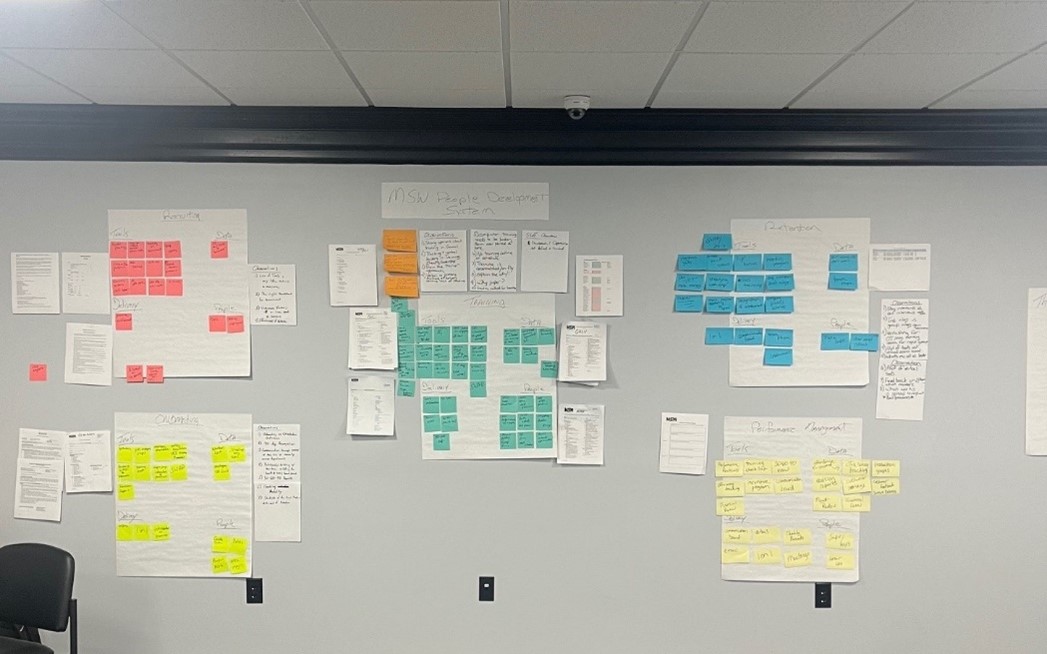
    Recognizing the need to help provide visibility to the structure and functions of the PDS and inspired by the Value Stream Map, my team developed the Talent Stream Map, a visual guide of all the components necessary to find, train, and retain people to help an organization meet its strategic goals.

    The structure of the TSM

    Four drivers

    The PDS is empowered and energized by the tools used, data collected, methods of delivery, and the people involved in the processes it houses. Once identified, these components are seen side by side and gaps and opportunities can be explored.

    Mapping the tools used in all the processes of the PDS allows the exploration of several helpful questions that can guide the discovery of  improvement ideas. For example,

    • Do we have all the tools needed?
    • When was the last time tools were updated?
    • Are we using tools like development pathways effectively across the PDS?
    • Are we leveraging the tools from one area to another across the whole PDS?

    Data is generally collected to help manage the PDS, if only at the basic level, which is fairly easy to track down. Comparing data across the whole of the PDS isn’t as simple. Gathering better data can inform better decisions. When mapped, gaps and opportunities for data collection become more obvious.

    • What data are we getting and are we actually using it?
    • What data is missing?
    • What correlations can be made from data across the five functional areas?
    • Are we asking the right questions of the data?

    Exploring the delivery of the process steps and services helps stakeholders to evaluate the effectiveness of the delivery and to identify potential improvements.

    • Are the methods of delivery up to date? (this relates to things like technology and to people’s expectations, etc.)
    • Is the timing of delivery right?
    • Where are we delivering these steps and services?
    • How can we improve the delivery?

    The people component of the PDS is one of the most important, and one of the most challenging to see. Leaders at all levels contribute to the PDS’s success or failure. Undoubtedly, frontline managers & supervisors impact the process of finding, training, and retaining employees. They are the main avenue of communication within the PDS – their influence even reaches the community. These important stakeholders impact culture, either positively or negatively.

    • Are the people involved in the PDS aware of their roles?
    • Are they trained to do their part (in each of the five areas)?
    • Are they held accountable for the success of the PDS?
    • How can we help people improve in their PDS related roles?

    Once the mapping effort has revealed who is involved with each area and how they are involved, those leaders and stakeholders can visually see how they fit into the system and understand how and why their contributions matter.  

    The purpose of the TSM

    To begin to improve a system, you must first establish its condition. The TSM is intended to make a complex, people-centric system more visible to identify gaps and opportunities that might go unseen otherwise.

    After the current state is established and understood, the next logical step is to begin to construct a future state map. This is where the strategy development starts. Stakeholders can make observations, express ideas and concerns, and begin the process of envisioning what the system could potentially look like.

    The value of the TSM

    Ideally, the TSM is built by all the stakeholders of the PDS. Those being all the individuals who supervise or manage others. As the process unfolds, stakeholders will see parts of the PDS that they may not have seen or fully understood before. There will be conversations that could reveal a misunderstanding of how certain functions are supposed to work versus how they actually work. Ideas, assumptions, and concerns can be voiced. Most importantly, mental models can be aligned, or the recognition of the various mental models can be dealt with.

    Waste reduction is the defining hallmark of lean thinking. The TSM helps teams isolate and reduce waste in the people development system. Waste in this system differs from waste in the traditional lean definition. Time, effort, and money are the main types of waste in the PDS, but there are also intangible wastes such as wasted opportunities and wasted potential.

    Using the TSM

    Making the complexities of the internal workforce development efforts visible can help teams in a number of ways.

    • Awareness. All stakeholders get a wholistic view of the system and their role within it.
    • Discovery. Identify gaps and opportunities across one of the most important organizational systems.
    • Dialog. One of the most valuable aspects of using the TSM is the conversations that occur during the map’s construction.

    Business leaders are weary of trying to solve the labor issues we are facing in our state and across the country. The Optimized People Development System and the Talent Stream Map were developed to help these leaders identify often unseen levers that they might manipulate to improve their methods to find, train, and retain the people they desperately need. They help leaders focus more on the things they can control and less on the things they cannot.

    The right map can make a journey more successful. The Talent Stream Map helps identify the “You are here” point in a journey toward improving your people development system. It serves as a great guide along the way, and it engages all the system stakeholders as they can make this improvement journey together.

    If you would like more information about either of these tools let us know. You can reach me through the comments here or at tim.waldo@tennessee.edu.

    Do us a favor please. If you construct a Talent Stream Map with your fellow stakeholders, please send us pictures and share your story. We love to learn how teams use these tools to improve their people development efforts.

  • The Most Important Element in the People Development System

    The Most Important Element in the People Development System

    Time has a way of pressing in on our awareness. Although the clock and the calendar can exert multiple influences, this awareness does not always lead to the same level of appreciation for time. I saw this recently on an exploration of the dual vocational training system in Germany. The Germans have developed a practical patience with regard to training their workforce. Their approach is underpinned by a deeper appreciation for the impacts that time can have when it comes to developing workers. At the organizational level, time affects all of the functional areas of the people development system.

    Obviously, time is not the only key element in the PDS. There’s also money, commitment, information, and leadership. Like the element of time, each of these is directly linked to all five functional areas of the PDS and each requires significant investment to optimize the system. What is unique about time is the speed at which impacts can appear. Typically, the consequences caused by the others, whether by absence or by presence, can show up rather quickly. This is not always the case with time.

    For example, an underappreciation of time in the PDS can:

    • Short circuit training efforts.
    • Rush recruiting initiatives.
    • Reduce onboarding to just orientation.
    • Dramatically lower the probability of retention.
    • Reduce the effectiveness of performance management.

    The outcomes of each of these failures, and many others related, may only show up in the future as low morale, weak overall performance, or lack of company growth, just to name a few. Unpacking the impacts of systems thinking in The Fifth Discipline, Peter Senge memorably pointed out, “Decisions and actions taken at some point in time have a delayed reaction or impact at a later time.”

    Operation of the PDS is suboptimal when time is undervalued. This is particularly true when it comes to human interactions. The wider role of the PDS is to facilitate;

    • Learning and development
    • Communication
    • Value exchange
    • Relationship building
    • Maintenance of the culture

    If process steps are truncated for the sake of expediency or the tyranny of the urgent, the organization and the individuals slowly suffer.  

    When the time for people to connect is actually invested, there are still the tools of the PDS to consider. Recruiting plans, onboarding plans, development pathways, and the process of performance management all require time to develop, deploy, and deliver results, not to mention the activities involved in training.

    Optimization, the actions of continuous improvement for the PDS, is an ongoing process that requires investment in all the elements listed above. If stakeholders who watch over the PDS are unable or unwilling to be patient; to invest adequate time for the system to operate properly, then the PDS cannot perform at its optimal level.

    Time can be a powerful partner or a formidable foe in our efforts to find, train, and retain talented people. We can’t control time, and it’s not enough to simply acknowledge its pressing influence. A more balanced approach is needed. One that keeps the sense of urgency to make progress and solve problems against the tension of the long-term investments in the system’s strategic success.

    Image by Tumisu from Pixabay 

  • What if Outsiders Saw Our People Development System?

    What if Outsiders Saw Our People Development System?

    If a group of strangers asked to visit your manufacturing facility to learn about your training and development efforts, what would they discover? How would you explain your organization’s approach to training and development? Would the collective attitude toward learning be evident as they walked around?  What would they learn from talking with trainees and trainers? Such a scenario could be exhilarating and validating. On the other hand, it could be challenging, possibly even embarrassing.

    Last month I was part of a group that visited six manufacturers, some large and some small, in Munich, Germany. Like so many before us, we wanted to learn about their much-vaunted dual training approach known as the Vocational Education and Training system. The companies welcomed us in, as did other system partners. They were gracious and eager to share.

    Switching Places

    The trip was co-sponsored by the American Council on Germany and by MAGNET. We were a collection of workforce development professionals mostly from a dozen Manufacturing Extension Partnership centers around the US. After the exploration, I wondered what would happen if the roles were reversed. What if it were my company and our people development system that a group of professionals wanted to see?

    Over our week-long exploration of these companies, we saw fully equipped, well-organized, and dedicated training areas with ongoing projects that young apprentices (some only 15 years old) had been working to complete. Conversations with several of these learners revealed a growing connection to the company and to the people investing in their futures. Would they see that level of investment if they came to my place?

    Seeing More

    We learned about requirements for trainers and how they are supported. We saw how the companies connected to the greater workforce development system. Leaders, from the C suite to the production teams were passionate about training the next generation. Would my visitors see such enthusiasm for developing people?

    Learning and development are valued at many different levels. In their view, this long-term endeavor connected individuals to teams and teams to industries. To our German hosts, these traditional educational efforts are important because, ultimately; they connect communities to the nation’s interests. Would such a level of appreciation for the overall impact of people development be evident in my facility?

    Walking around each factory, we experienced a bit of their cultures. In every instance, there were positive attitudes toward learning. In some cases, about half of the existing workforce had traveled the same type of career development path, which no doubt helps form bonds and provide encouragers for the apprentices. Clear development pathways were the norm. The level of commitment to learning was high and very consistent. Would my company culture send the same messages?

    Self-reflection

    These German companies let outsiders peek under the hood of their people development system. Undoubtedly, the whole German system drives the success of the VET process. However, inviting people in to see your operation is much more up close and personal. I don’t actually lead a manufacturing company, but I suspect it requires some serious self-reflection beforehand.

    Opening up your internal system for inspection and critique requires a certainty that the system is working well, that the tools are effective, and the performance is reliable. The confidence to throw open the cupboards would have to be based on clear successes and on knowing that the system is capable of serving future needs. It would take faith in your team as well. If visitors talked one on one with learners and trainers the strengths or weaknesses of the system could be exposed.

    Optimization of the PDS is the pursuit of answers to questions that force us to look closely at the whole system and its performance. Seeing it from the perspective of others is a good exercise. If it validates our beliefs and our actions, great. If sharing some aspects of our system makes us uncomfortable, these are the areas that need attention.

    What would other professionals see if they looked closely at our PDS? Maybe we should invite them in and find out. But, only after we’ve looked through the cupboard ourselves!

    Image by Tumisu from Pixabay 

  • What it Means to Optimize a People Development System

    What it Means to Optimize a People Development System

    In some instances optimization is a moving target. Continually improving a system that is influenced by several stakeholders and operates on many levels is challenging. Add in the fact that many system functions can occur at many different times – some overlapping, some sequentially, some unknown to most stakeholders – and you have an idea of how much the target can move. That is the nature of an organization’s people development system. Interestingly, these dynamics present some unique enhancement opportunities.

    The Obvious

    On one level, optimization of the PDS means striving to continuously improve the system’s functions by identifying efficiencies. For example, how people are logically and effectively moved through the system, how data is captured, how PDS tools are deployed, etc.

    There are also opportunities to engage all stakeholders through stronger communication and more robust connections. This might look like monitoring the types of messages being sent and received across the PDS, fostering relationships through mentoring, and creating strong visual communication pieces such as training matrices.

    This is the practical, operational side of the PDS. Other improvements at this level might involve upgrading tools like individualized onboarding schedules and development pathways.

    The Less Obvious

    Because the system is concerned with people, there is another level that is more intuitive and driven by emotion. On this level, optimization can mean things like strategically aligning the values of all PDS customers.

    The customers of the PDS are 1) the people being trained, 2) the organizational teams that those trained people will join, and 3) the organization itself. Each of these customers bring specific values and expectations, some of which are often unspoken. The PDS is responsible for facilitating the exchange of these ideals. This requires constant attention and constant affirmation that the value brought is appreciated.

    As the PDS continues to improve and become more effective, it allows each customer to consistently contribute value to the other customers and fulfill certain expectations of growth, performance, and of learning.

    Optimization on this level can also include creating and sustaining a very particular awareness. It needs to register with the individual at an emotional level that the organization wants them to grow and thrive. This perception feeds self-efficacy and helps create and strengthen bonds.

    This is more than overt communication. This type of awareness is ultimately fed by the culture, the level of enthusiasm that leaders exhibit about learning, the consistency of the expectations to learn and grow, and even the amount of money invested. These types of signals speak volumes about the organization’s level of commitment to developing people.

    At this level of the PDS, personal commitment and a willingness to engage are nurtured. Optimization requires first that leaders understand the nuances of this level of performance in the PDS and second that they maintain a commitment to constantly monitor it for improvement.

    Appreciating the Levels

    Due to multiple levels of complexity, it takes a very focused effort to see the complete PDS that operates within an organization. Seeing the obvious opportunities as well as those less obvious but still powerful movers requires that all stakeholders have a holistic understanding of the system, including those influential levels where bonds are created and emotions are engaged.

    Image by Gerd Altmann from Pixabay

  • Optimized PDS Drivers

    Optimized PDS Drivers

    This is the system that gets things done. It is arguably the most important system within an organization; literally empowering all other organizational systems – production, procurement, quality, and business operations. It is the system that cultivates talent and creativity, supplies ideas and powers implementation. It puts faces and names to the organization’s culture by attracting, training, and retaining people. Practically every organization has this workforce development system in some form, operating at some level of performance, although, it is a very difficult system to see. Its elements function at multiple levels, with many different stakeholders, and at various times as the organization marches toward its vision. Because this system is so vital to the overall organization, it makes sense to continuously improve its capabilities. It makes sense for all stakeholders to optimize their people development system (PDS).

    Four Key Drivers

    An act, process, or methodology of making something (such as a design, system, or decision) as fully perfect, functional, or effective as possible – this is, according to Merriam-Webster.com, the definition of optimization. Continuous improvement is to pursue optimization relentlessly. For the PDS it means an intense, long-term effort to:

    • Optimize the purpose
      • Know the why behind the objectives that drive the PDS.
      • Establish higher standards and expectations.
    • Optimize processes
      • Make the complete system visible.
      • Understand and improve the connections between system elements.
      • Remove waste and inefficiency.
    • Optimize performance
      • Utilize system elements more effectively.
      • Use more and better data to make decisions.
      • Sustain the system.
    • Optimize people
      • Expanding the idea and concept of development across the system to include:
        • Professional growth
        • Personal progress
        • Facilitating relationships
        • Enhancing culture

    Three Key Tools

    Optimizing the PDS is the ongoing process of improving and aligning these key drivers so that all other organizational systems have the support needed to achieve business goals and objectives. There are three key tools that support this journey toward a more powerful and effective people development system. Systems thinking brings connections to light, illuminating system behaviors. Lean thinking helps to identify waste and keep the team focused on continuously pursuing perfection. And foundationally, the concepts supporting a learning organization help to sustain a more robust PDS and enhance employee engagement.  

    I look forward to exploring the different facets of optimization for the PDS in future posts. I would love to learn from your experiences too. How have you seen this optimization play out within your organization?