In the context of the PDS the fourth lean principle can be challenging to envision, because of the element of time. Still, the concept can be useful to stakeholders.
Principle 4 – Establish pull.
Like the principle of flow, this principle is about movement through a system. If you can’t attain one piece flow in a production system, then the goal would be to establish pull, whereby the next operation gets what is needed, when it is needed so that various types of waste are minimized.
Using this lean thinking to monitor movement through the PDS helps by reminding stakeholders that progress and movement should be constant. People should be advancing. How many are moving? Which areas need more movement? If there is no movement, what actions should be taken to restart it? Having this mindset focuses attention on the near term by keeping the team engaged and growing, and on the long term by ensuring that the future talent needs of the organization can be met.
How Pull Happens in the PDS.
New opportunities create pull in this system. People are needed (pulled) into new roles when new capabilities and capacity require people to take on new challenges. The principles of flow and pull help PDS leaders identify which positions/disciplines are moving through the other organizational systems. Keeping a watchful eye on these two forces can inform stakeholders about needed adjustments to the system.
In the PDS, a type of pull is established when the organization or the organizational systems have a need for people due to three factors:
Growth – new business, new capacity, acquisitions
Expansion – addition of new technology, new capabilities, or products
Success – increase in business, new markets, or productivity
Advancing through the PDS is usually gradual and repetitive in nature. Some of the operations of the system – training, performance management, etc. – happen over and over again, making them difficult to track.
In this case, pull is accommodated not only by promotions, but also by skill level advancement and growth in leadership, cognitive training, personal goal attainment, knowledge acquisition, coaching ability, cross training in other areas, concept understanding (such as lean, kata, systems thinking, etc.), strategic thinking, etc.
Seeing the movement in the PDS.
Systems thinking really helps when applying these principles to the PDS. Is the system moving people along their development pathways? This requires the PDS to prepare people through the performance management process and through the training process using tools like the development pathways. Of course, retention must be strong as well.
The pull effect can be identified by monitoring the needs of the three internal PDS customers and ensuring that people are positioned to move at the appropriate time. Timely data and effective communication practices are necessary for this to occur.
Bottom line, using the lean principles of flow and pull to manage the PDS helps all stakeholders monitor the progress people are making as they prepare for new roles and work to gain new capabilities to help the business succeed.
Next time, the fifth lean principle – the pursuit of perfection!
Maps have long captured the imagination of countless generations. Whether in search of some fantastic treasure, some lost or forgotten land, or something more practical like finding the way home, maps have played a key role in human civilization. There are many types of maps helping to answer questions like, where are we now, and where are we going? What type of journey will this be, and how should we prepare?
These useful charts are for more than just simply changing physical locations though. Some maps can provide perspective and illuminate potential. Business leaders often use maps to identify improvement opportunities for their systems and processes. There are a few tried and true mapping tools that leaders have relied on for years in these efforts. Choosing the right tool is an important first step.
Lean manufacturing aficionados understand that details are important in pursuit of continuous improvement. The Value Stream Map has been used for years to visually represent all the steps involved in a process. The beauty of the VSM is its ability to show clear connections between process steps, information flows, and material flows.
However, there is a system where the traditional VSM is not the best map to allow a team to see the inner workings of a particularly important system. A system that could certainly benefit from continuous improvement efforts.
Introducing the Talent Stream Map
An organization’s internal workforce development efforts form a system, known by my team as their People Development System. It is comprised by five functional areas – recruiting, onboarding, retention, performance management, and the heart of the system, the training process.
The PDS is a complex, non-linear system. Its functions and activities occur at various times, with multiple stakeholders, in many places across the organization. For example, retention efforts on second shift, multiple training activities on all shifts, and a conversation over lunch regarding performance improvement opportunities. And, of course, the PDS does not produce a “finished” product. People should always be receiving training and getting performance management support. Retention efforts are also never ending.
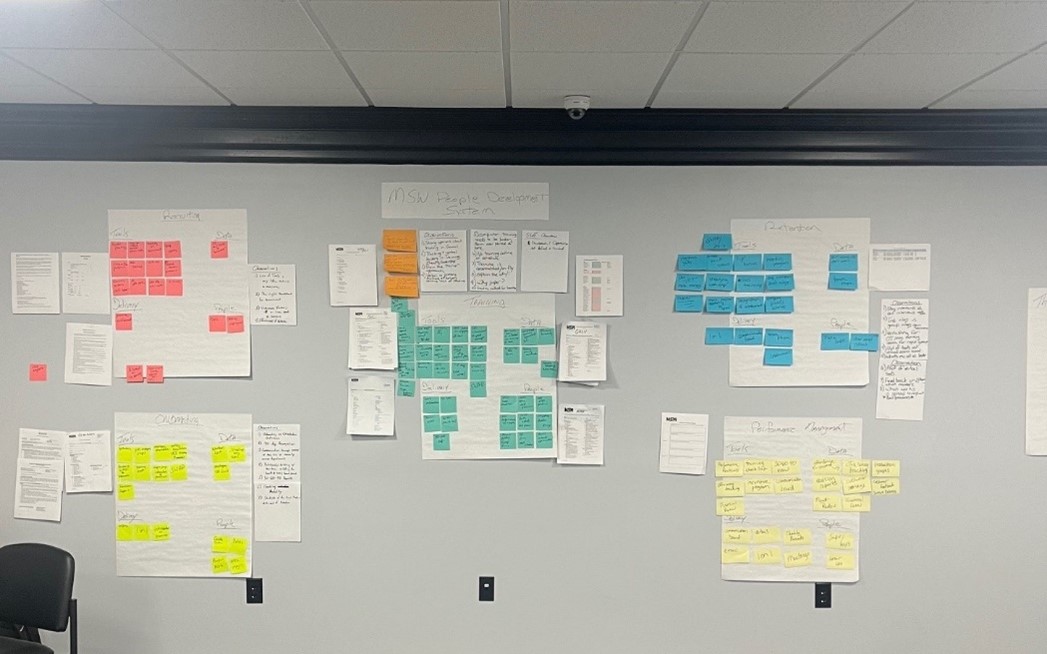
Recognizing the need to help provide visibility to the structure and functions of the PDS and inspired by the Value Stream Map, my team developed the Talent Stream Map, a visual guide of all the components necessary to find, train, and retain people to help an organization meet its strategic goals.
The structure of the TSM
Four drivers
The PDS is empowered and energized by the tools used, data collected, methods of delivery, and the people involved in the processes it houses. Once identified, these components are seen side by side and gaps and opportunities can be explored.
Mapping the tools used in all the processes of the PDS allows the exploration of several helpful questions that can guide the discovery of improvement ideas. For example,
Do we have all the tools needed?
When was the last time tools were updated?
Are we using tools like development pathways effectively across the PDS?
Are we leveraging the tools from one area to another across the whole PDS?
Data is generally collected to help manage the PDS, if only at the basic level, which is fairly easy to track down. Comparing data across the whole of the PDS isn’t as simple. Gathering better data can inform better decisions. When mapped, gaps and opportunities for data collection become more obvious.
What data are we getting and are we actually using it?
What data is missing?
What correlations can be made from data across the five functional areas?
Are we asking the right questions of the data?
Exploring the delivery of the process steps and services helps stakeholders to evaluate the effectiveness of the delivery and to identify potential improvements.
Are the methods of delivery up to date? (this relates to things like technology and to people’s expectations, etc.)
Is the timing of delivery right?
Where are we delivering these steps and services?
How can we improve the delivery?
The people component of the PDS is one of the most important, and one of the most challenging to see. Leaders at all levels contribute to the PDS’s success or failure. Undoubtedly, frontline managers & supervisors impact the process of finding, training, and retaining employees. They are the main avenue of communication within the PDS – their influence even reaches the community. These important stakeholders impact culture, either positively or negatively.
Are the people involved in the PDS aware of their roles?
Are they trained to do their part (in each of the five areas)?
Are they held accountable for the success of the PDS?
How can we help people improve in their PDS related roles?
Once the mapping effort has revealed who is involved with each area and how they are involved, those leaders and stakeholders can visually see how they fit into the system and understand how and why their contributions matter.
The purpose of the TSM
To begin to improve a system, you must first establish its condition. The TSM is intended to make a complex, people-centric system more visible to identify gaps and opportunities that might go unseen otherwise.
After the current state is established and understood, the next logical step is to begin to construct a future state map. This is where the strategy development starts. Stakeholders can make observations, express ideas and concerns, and begin the process of envisioning what the system could potentially look like.
The value of the TSM
Ideally, the TSM is built by all the stakeholders of the PDS. Those being all the individuals who supervise or manage others. As the process unfolds, stakeholders will see parts of the PDS that they may not have seen or fully understood before. There will be conversations that could reveal a misunderstanding of how certain functions are supposed to work versus how they actually work. Ideas, assumptions, and concerns can be voiced. Most importantly, mental models can be aligned, or the recognition of the various mental models can be dealt with.
Waste reduction is the defining hallmark of lean thinking. The TSM helps teams isolate and reduce waste in the people development system. Waste in this system differs from waste in the traditional lean definition. Time, effort, and money are the main types of waste in the PDS, but there are also intangible wastes such as wasted opportunities and wasted potential.
Using the TSM
Making the complexities of the internal workforce development efforts visible can help teams in a number of ways.
Awareness. All stakeholders get a wholistic view of the system and their role within it.
Discovery. Identify gaps and opportunities across one of the most important organizational systems.
Dialog. One of the most valuable aspects of using the TSM is the conversations that occur during the map’s construction.
Business leaders are weary of trying to solve the labor issues we are facing in our state and across the country. The Optimized People Development System and the Talent Stream Map were developed to help these leaders identify often unseen levers that they might manipulate to improve their methods to find, train, and retain the people they desperately need. They help leaders focus more on the things they can control and less on the things they cannot.
The right map can make a journey more successful. The Talent Stream Map helps identify the “You are here” point in a journey toward improving your people development system. It serves as a great guide along the way, and it engages all the system stakeholders as they can make this improvement journey together.
If you would like more information about either of these tools let us know. You can reach me through the comments here or at tim.waldo@tennessee.edu.
Do us a favor please. If you construct a Talent Stream Map with your fellow stakeholders, please send us pictures and share your story. We love to learn how teams use these tools to improve their people development efforts.
It just sounds wrong to ask such a question. It feels insensitive, almost Orwellian in a way. Should people be considered inventory? Applying lean thinking to a system requires that we look at all the components, and inventory can certainly be a major factor. But, in this case, we’re not talking about a store of things, a list of items on shelves or in boxes. We’re talking about people.
Inventory is one of the famous wastes in lean thinking. Usually, the goal is not to have too much or have it before it’s needed; this is because lean concepts originated from manufacturing. However, applying lean concepts to a people development system (PDS) can challenge the definition of inventory.
Exactly Where are the People?
I was talking to a colleague about helping organizations optimize their PDS by applying lean thinking. As we discussed how to analyze the traditional wastes of lean, my friend suggested that the stack of applications that an organization has for open job postings represents a type of inventory. That stack could be seen as an inventory of raw materials ready to be processed by the PDS. Potential, raw talent, waiting to be built up.
Extending the analogy, perhaps these are other types of human inventories:
Work in Progress – Those individuals involved in training and development.
Finished Goods – No one is ever fully finished learning, but these are reaching their peak in their role.
Reworks – those who recognize the need to change and are open to the idea of upskilling and retraining.
Obsolete Inventory – those people in the organization who refuse to change or whose roles are disappearing.
There is also just the overall headcount. Donella Meadows, a leading contributor to systems thinking, often referred to stocks as the foundation of any system. She bolsters this assertion saying, “Stocks are the elements of the system that you can see, feel, count, and measure at any given time.” In the people development system, headcount is the stock, making it a type of inventory; one that can fluctuate by being acted upon by a system’s feedback loops, either a balancing loop or a reinforcing loop, or a combination of both. The PDS is responsible for maintaining the stock of people in all the organizational systems.
Working Their Way Through the System
Looking at people as inventory in some instances can be helpful. For example, two key lean principles are establishing flow and creating a pull system.
Flow
In this instance, flow represents people successfully moving through the system. It happens when the recruiting process is continually finding and developing acceptable/trainable talent at all key positions. It is created by constantly looking for valuable attributes and talents, even if there is no signal from internal customers. Then, creating the opportunity for those attributes and talents to “flow” into other parts of the organization; for the good of the individual and the organization.
Flow is not just about people physically moving through the system though. It is also about intellectual movement, emotional movement, and cognitive movement. Flow implies progress and growth. The optimized PDS creates flow by ensuring that everyone is moving (upwardly, laterally) – progressing along their development path, career ladder, skill levels, etc.
Pull
Pull is demand. It is created in the organization when there’s a need for people to move up, take on new roles, or add their capabilities to another team. Pull is established when organizational systems have a need for people due to growth, expansion, and success. The Optimized PDS helps find the right types of human inventory, at the right place, in the right quantity.
Pull is driven by more than just promotions. There’s also skill level advancement and growth in leadership abilities, cognitive training, personal goal attainment, knowledge acquisition, coaching ability, cross-training in other areas, concept understanding (such as lean, kata, systems thinking, etc.), and strategic thinking.
Signals From the System
Together, the lean concepts of flow and pull help PDS stakeholders identify where needs are greatest and the pulling forces are strongest. These signals get transmitted back through the PDS so that the demand is met, people are added, they get training, are moved, etc. They will have names and faces, of course. They won’t be known as Works in Progress, or Reworks, or Obsolete. They will, however, be seen in the system.
There are places in the PDS where monitoring the levels of human inventory and their developmental progress can interject a sense of urgency to ensure that people are efficiently moving through the system and they are being served well along their journey. Just the idea of labeling people as inventory may be inflammatory or sound demeaning to some. If it is meant to value people only as so many interchangeable resources to be manipulated, then it would be offensive. However, observing the PDS through this lens can help us gain a more systems-oriented view and help us manage the organization’s most important inventory.
Reference – D. H. Meadows, (2008). Thinking in Systems, A Primer.
There were politicians, educators, and soldiers. Locals, including activists and consultants, were in the gathering along with a few business leaders. Although these types of events ultimately aim to support local businesses, there are typically only a few industry leaders at a workforce development conference like this one. But on this day, several employers showed up. The folks concerned with growing the workforce in the Tri-Cities region of east Tennessee came together yesterday in their annual Education to Employment Summit. This E2E Summit is a great example of a regional workforce development system communicating needs, sharing best practices, and celebrating successful initiatives that connect real people to good jobs. There were three important takeaways for organizations seeking to optimize their internal people development systems (PDS).
A commitment to connections
Cultivate multiple and meaningful relationships
Diversity means more and matters more
A PDS Can’t Operate in a Vacuum
For an organization, making connections seems obvious, however, being committed to more and better connections to strengthen their workforce takes increased dedication and effort. A mediocre PDS might join the local chamber of commerce or occasionally sit in on an industry roundtable discussion. The optimized PDS will sustain a variety of meaningful associations. The E2E Summit, for example, highlighted the Talent Pipeline Management initiative from the US Chamber of Commerce. TPM works to assemble multiple employers within a region to identify workforce needs so that the greater workforce system can take timely steps to meet those needs. The annual Career Quest Tennessee event seeks to connect K-12 students and teachers with employers and with hands-on experiences designed to expose them to career options. Other panels discussed how to connect with veterans exiting the armed services and how to connect future employees with work-based learning opportunities. How well is the organization’s PDS connected to these types of initiatives? Maintaining connections like these takes effort and time. However, the investment can pay handsome dividends when it comes time to increase staffing levels or to fill key job openings.
Many Relationships
It was repeated over and over again – building relationships is an important key to sustaining a workforce. Similar to connections, something else that seems like a no-brainer. However, those seeking to optimize their PDS would do well to examine how their system is built to support relationship building.
Every panel at the E2E Summit touched on this theme of relationships. Two high school students involved in apprenticeships with Eastman Chemical and Dreicor described the importance of the relationships they’ve enjoyed with the people at their new workplaces. These bonds were obviously instrumental in their continuing on their training path. Retired soldiers talked about the need to build relationships with veterans transitioning into civilian life because only through relationships could employers begin to understand some of the unique challenges these potential team members faced. Entrepreneurs talked about the support and mentorships they enjoyed with chambers of commerce and educators and how those relationships made all the difference in their being successful. The gold to be mined from this theme is that the optimized PDS will continuously seek to improve how they build and sustain relationships. Developing thriving partnerships with the larger workforce development system, and more importantly, ensuring that their own internal workforce development efforts cultivate meaningful relationships with all team members. Becoming exceptional at relationship building, not just being average, can be a real competitive advantage for an organization.
Include Many
Like countless others, this workforce development system is working to promote an inclusive culture in their area. For a variety of reasons – social, economic, and cultural – there is a need to ensure that everyone has a chance to thrive. Highlighting that it is a community-wide need, the United Way of Greater Kingsport presented a wonderful video about how welcoming the Tri-Cities area is for all people. It was from the perspective of teachers of color, some from different nations, and all from a variety of backgrounds. The community has obviously worked very hard to welcome folks to the region. At the organizational level, the optimized PDS actively considers that the workers in their organization have families that interact with other communities and have specific needs and concerns. Such a system echoes the welcoming message that the community initiates.
There’s also diversity of experiences. The panel discussing transitioning service members helped the attendees to better understand the unique experiences that these potential team members have and the obstacles that might prevent them from successfully adapting to civilian teams. People from different places and backgrounds have seen different things. They have a variety of experiences that could prove extremely valuable if these are welcomed and the environment allows for open sharing. The average PDS may have a narrow view of diversity, equity, and inclusion. The optimized PDS embraces the differences and the value that might be realized by adding new and different people to the mix.
Optimization means taking PDS connections to a higher level. It includes being more diligent about building and sustaining relationships both internally and externally. Continuously improving the systems used to develop people includes valuing a wide array of people and what each can contribute. The E2E Summit presented a great picture of the work that regional workforce development systems do to ensure that they can attract a robust workforce. The job of the organization’s internal people development system is to continually seek out ways to enhance and improve its processes so that both of these systems can realize a healthy ROI.




 The Optimized People Development System