
Maps have long captured the imagination of countless generations. Whether in search of some fantastic treasure, some lost or forgotten land, or something more practical like finding the way home, maps have played a key role in human civilization. There are many types of maps helping to answer questions like, where are we now, and where are we going? What type of journey will this be, and how should we prepare?
These useful charts are for more than just simply changing physical locations though. Some maps can provide perspective and illuminate potential. Business leaders often use maps to identify improvement opportunities for their systems and processes. There are a few tried and true mapping tools that leaders have relied on for years in these efforts. Choosing the right tool is an important first step.
Lean manufacturing aficionados understand that details are important in pursuit of continuous improvement. The Value Stream Map has been used for years to visually represent all the steps involved in a process. The beauty of the VSM is its ability to show clear connections between process steps, information flows, and material flows.
However, there is a system where the traditional VSM is not the best map to allow a team to see the inner workings of a particularly important system. A system that could certainly benefit from continuous improvement efforts.
Introducing the Talent Stream Map
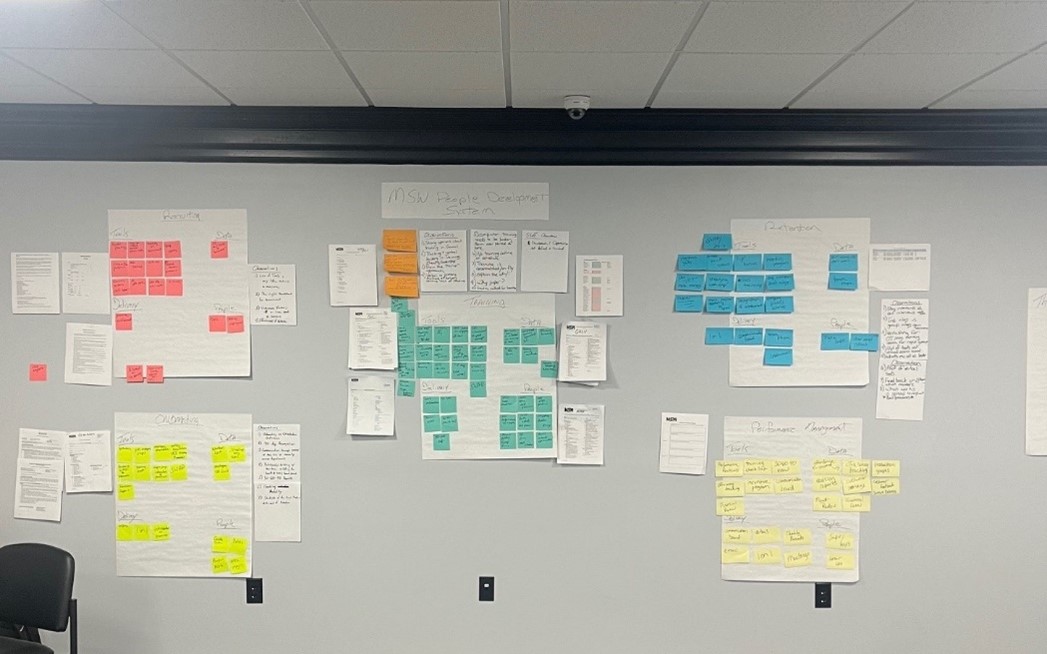
An organization’s internal workforce development efforts form a system, known by my team as their People Development System. It is comprised by five functional areas – recruiting, onboarding, retention, performance management, and the heart of the system, the training process.
The PDS is a complex, non-linear system. Its functions and activities occur at various times, with multiple stakeholders, in many places across the organization. For example, retention efforts on second shift, multiple training activities on all shifts, and a conversation over lunch regarding performance improvement opportunities. And, of course, the PDS does not produce a “finished” product. People should always be receiving training and getting performance management support. Retention efforts are also never ending.
Recognizing the need to help provide visibility to the structure and functions of the PDS and inspired by the Value Stream Map, my team developed the Talent Stream Map, a visual guide of all the components necessary to find, train, and retain people to help an organization meet its strategic goals.
The structure of the TSM

Four drivers
The PDS is empowered and energized by the tools used, data collected, methods of delivery, and the people involved in the processes it houses. Once identified, these components are seen side by side and gaps and opportunities can be explored.
Mapping the tools used in all the processes of the PDS allows the exploration of several helpful questions that can guide the discovery of improvement ideas. For example,
- Do we have all the tools needed?
- When was the last time tools were updated?
- Are we using tools like development pathways effectively across the PDS?
- Are we leveraging the tools from one area to another across the whole PDS?
Data is generally collected to help manage the PDS, if only at the basic level, which is fairly easy to track down. Comparing data across the whole of the PDS isn’t as simple. Gathering better data can inform better decisions. When mapped, gaps and opportunities for data collection become more obvious.
- What data are we getting and are we actually using it?
- What data is missing?
- What correlations can be made from data across the five functional areas?
- Are we asking the right questions of the data?
Exploring the delivery of the process steps and services helps stakeholders to evaluate the effectiveness of the delivery and to identify potential improvements.
- Are the methods of delivery up to date? (this relates to things like technology and to people’s expectations, etc.)
- Is the timing of delivery right?
- Where are we delivering these steps and services?
- How can we improve the delivery?
The people component of the PDS is one of the most important, and one of the most challenging to see. Leaders at all levels contribute to the PDS’s success or failure. Undoubtedly, frontline managers & supervisors impact the process of finding, training, and retaining employees. They are the main avenue of communication within the PDS – their influence even reaches the community. These important stakeholders impact culture, either positively or negatively.
- Are the people involved in the PDS aware of their roles?
- Are they trained to do their part (in each of the five areas)?
- Are they held accountable for the success of the PDS?
- How can we help people improve in their PDS related roles?
Once the mapping effort has revealed who is involved with each area and how they are involved, those leaders and stakeholders can visually see how they fit into the system and understand how and why their contributions matter.
The purpose of the TSM
To begin to improve a system, you must first establish its condition. The TSM is intended to make a complex, people-centric system more visible to identify gaps and opportunities that might go unseen otherwise.
After the current state is established and understood, the next logical step is to begin to construct a future state map. This is where the strategy development starts. Stakeholders can make observations, express ideas and concerns, and begin the process of envisioning what the system could potentially look like.
The value of the TSM
Ideally, the TSM is built by all the stakeholders of the PDS. Those being all the individuals who supervise or manage others. As the process unfolds, stakeholders will see parts of the PDS that they may not have seen or fully understood before. There will be conversations that could reveal a misunderstanding of how certain functions are supposed to work versus how they actually work. Ideas, assumptions, and concerns can be voiced. Most importantly, mental models can be aligned, or the recognition of the various mental models can be dealt with.
Waste reduction is the defining hallmark of lean thinking. The TSM helps teams isolate and reduce waste in the people development system. Waste in this system differs from waste in the traditional lean definition. Time, effort, and money are the main types of waste in the PDS, but there are also intangible wastes such as wasted opportunities and wasted potential.
Using the TSM
Making the complexities of the internal workforce development efforts visible can help teams in a number of ways.
- Awareness. All stakeholders get a wholistic view of the system and their role within it.
- Discovery. Identify gaps and opportunities across one of the most important organizational systems.
- Dialog. One of the most valuable aspects of using the TSM is the conversations that occur during the map’s construction.
Business leaders are weary of trying to solve the labor issues we are facing in our state and across the country. The Optimized People Development System and the Talent Stream Map were developed to help these leaders identify often unseen levers that they might manipulate to improve their methods to find, train, and retain the people they desperately need. They help leaders focus more on the things they can control and less on the things they cannot.
The right map can make a journey more successful. The Talent Stream Map helps identify the “You are here” point in a journey toward improving your people development system. It serves as a great guide along the way, and it engages all the system stakeholders as they can make this improvement journey together.
If you would like more information about either of these tools let us know. You can reach me through the comments here or at tim.waldo@tennessee.edu.
Do us a favor please. If you construct a Talent Stream Map with your fellow stakeholders, please send us pictures and share your story. We love to learn how teams use these tools to improve their people development efforts.


Leave a comment