Savviness is always a moving target. After all, it is an exercise of continuous learning requiring time, effort, and a determined focus. The dictionary defines savvy as having or showing perception, comprehension, or shrewdness especially in practical matters. For frontline supervisors and managers in manufacturing, artificial intelligence and automation are demanding the ability to exercise these powers in a fast-moving convergence.
Savvy Times Two
Knowing people, how they behave, navigate change, absorb information, etc., has always been a necessary capability of successful leaders. They utilize their understanding of people, their comprehension of situations, and their communication skills to guide the team to success.
For manufacturing managers, being technically savvy has also been a requirement. They should understand the product, the processes, the tools, and the equipment, to help the team achieve its goals. Add to this the urgency to acquire knowledge of AI and automation and how these technologies can impact operations.
Now, in this new era of AI, tech savviness has a new people component. A new leadership challenge that encompasses comprehending not only how people interact with technology, but how they react to it as well. Envisioning how to protect them while encouraging them to use technology to its fullest. And being shrewd enough to manage the team when new “superstars” arise as AI champions.
Successful AI implementation and ROI have eluded many organizations because they failed to see the necessary combination of tech savviness along with people savviness. Jay Titus, in a recent article for Industry Week, made the case for retaining middle managers and augmenting their training in the age of AI. The article highlighted that adoption and scaling of AI have technical aspects, cultural aspects, and structural aspects. As he rightly concludes, “…something that executives can mandate from above, but middle management is ideally positioned to carry out.”
Leaders at all levels should be prepared for the fact that there will be significant changes to the behaviors of organizational systems as these two disciplines evolve and combine. Changes that are crucial to effective technology adoption. Ripe opportunities for a new approach to savvy leadership and opportunities to optimize the most important of organizational systems, the people development system.
Guiding Change
To carry out this mandate, this new savviness requires mid-level management to become proficient in important skills that may well include some new topics for many of them.
They should be well versed in systems thinking so that they can understand how AI and automation will impact operations and the people involved in those operations. There is also trust building. These managers can nurture trust in two directions – trust in the technology and trust between team members as new AI powered agents and assistants join the team.
Consider the case for middle managers with well-developed AI fluency. Imagine a machine operator who is interested in AI. That operator goes and learns about AI and wants to use it to improve their work, so they talk with their supervisor. At a minimum, the supervisor, to be effective in this scenario, would need to understand what is being discussed. The supervisor would also need to understand the implications to the operation if AI tools or decision-making support were deployed.
That same supervisor would need to know how to lead in other nuanced ways. For example, if someone’s identity is threatened by an AI agent that suddenly makes knowledge and information available to everyone, the tech+people savvy manager will need to understand these implications and armed with sound training as a coach, be able to help this team member with the transition.
Savvy Orchestrators
Titus portrays middle managers differently, encouraging organizations to consider their role as evolving with technology. “When middle managers have the skills to understand the technology, to redesign workflows to take advantage of it, and to coach their teams toward higher-quality outputs, AI stops being a question mark and becomes a powerful strategic asset.”
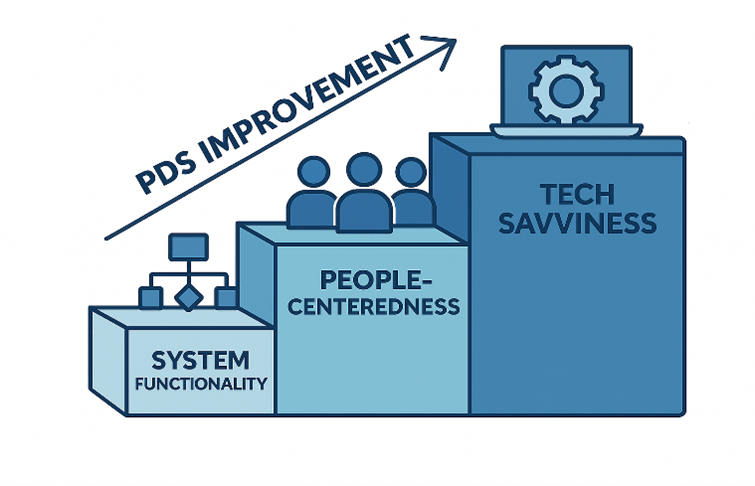
The organization’s people development system is the vehicle for helping these leaders evolve into this new era of technology and ensuring that the culture is people centered. The PDS can enhance a new type of savviness for these managers while helping them understand the impacts on people when adopting technology. Increasing the probability of benefiting from technology adoption.
Organizations that are able to look past the cool parts of AI and automation adoption – the tools and capabilities – and see the effects on people and organizational systems will recognize the value of developing a new set of leadership competencies in their mid-level management ranks. Abilities that will create a new kind of tech+people savvy leader.
Image AI generated.









 The Optimized People Development System