
It is a complex endeavor, hard to quantify, easily destroyed, and we have been unable to improve it for 30 years. And now, it’s getting more difficult to manage, even as it continues to be one of the most vital elements of the success of our systems. Sustaining employee engagement has proven to be tough, and in the era of AI it is increasingly essential that we figure it out.
The irony is that successful adoption of AI and employee engagement share similar requirements. Both need more human centricity – better connections between people, ensuring that people find their place, and effective ways to align purposes (both the individual’s purposes and the organization’s). Fortunately, most organizations already have a system to help with these. The key is to optimize that system to the mutual benefit of the organization and the team.
Connecting
Relationships are the currency of employee engagement. Yet, this idea often gets lost in the AI discussion. In most of the conversations I’ve had recently with manufacturing leaders and AI proponents, they are laser focused on the new tools, applications, and capabilities of the technology.
When I ask about their team and how adopting technologies might affect their people, many tend to hesitate, some are genuinely surprised by the question. They are thinking deeply about how AI will impact production systems, logistics, engineering, and other vital systems. But the system that gets very little attention is the most important one.
Morag Barrett penned a recent article for Fast Company addressing the impact of AI on relationship where he made this observation, “The quality of connection between human beings is the single most important variable in every system we’re worried about, and it’s the one we’re all still treating as optional.”
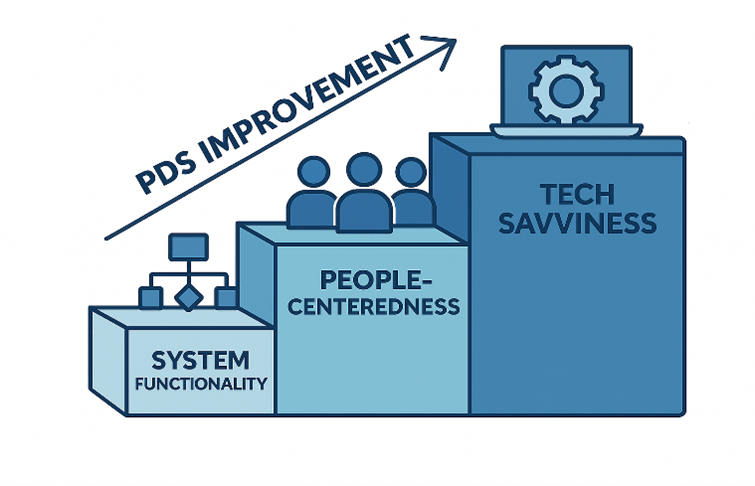
An organization’s people development system encompasses their internal workforce development efforts. It’s the system that promotes relationships, communicates to system stakeholders, and helps create culture, among many other functions. Importantly, it is a system that can be improved upon. This is the premise of the OPDS framework.
After improving system functionality, the second level of optimization for the OPDS is People Centeredness where stakeholders explore and improve the system’s capacity for developing people, where learning organization concepts are applied, and where the work of relationships is emphasized.
Graphic by ChatGPT
This is the level of improvement where leaders consider if the PDS is supporting the uniquely human work that is required to make the most of AI and automation. The key questions here are: does our PDS really serve people well? Does it foster engagement on multiple levels? Does it promote the human in the loop aspects required by AI adoption?
Belonging
Being engaged at work has many facets. This is part of the complexity involved. Some would say that the relationship between employer and employee is a type of social contract. But it’s more than that. Engagement is an emotional decision that drives commitment and investments of time, energy, and dedication. It’s more than just an agreement of you pay me; I give you this.
Addressing the fear that AI could potentially disrupt the work-for-wages balance, Barrett asked, “What happens to dignity, purpose, and identity when contribution is decoupled from compensation? Work has never been just about money. It’s been about belonging to a team, a mission, a community of people who need what you bring. What happens when that belonging is no longer guaranteed?”
Being mutually committed and relationally connected underpins belonging. The optimized PDS intentionally fosters a culture where people know they are valued and know they share some responsibility for the wellbeing of the organization and for the people they work alongside. Everyone makes sure everyone belongs. That takes strong leadership, great communication, and a shared determination.
Purpose
The pursuit of purpose and meaning is an age-old search; it has never been owned by one generation. However, what has changed is how the search for these has moved up the ranks of priorities in the realm of work.
Mark Twain famously said, “The two most important days in your life are the day you are born and the day you find out why.” It seems that work has always played an outsized role in defining one’s purpose and in the age of AI, purpose is one of many constructs under threat.
The optimized PDS comprehends that both the organization and the individual team members are motivated by purpose, so the system strives to know what those purposes are and help every team member in their journey toward their purpose.
System stakeholders have frequent conversations with members and track their progress to ensure the connection to purpose. There are structured learning opportunities, for example through a personalized individual development plan. Retention efforts and performance management efforts help support the journey as relationships within the team provide encouragement and accountability.
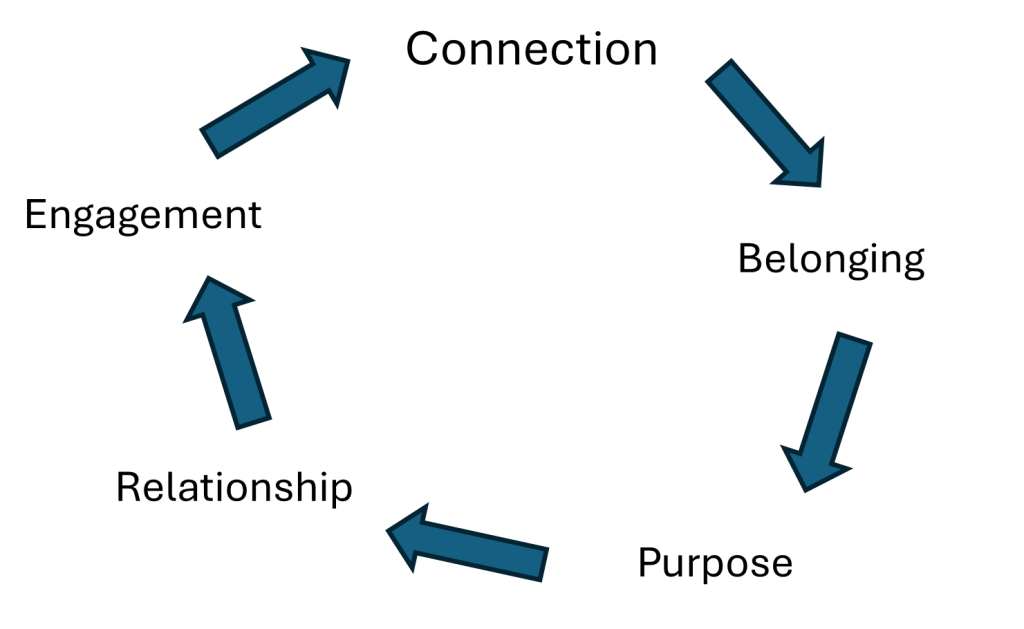
Being connected, having a sense of belonging, and understanding one’s purpose helps to create a virtuous cycle. Interestingly, both the organization and the individual value this cycle. Each is encouraged and strengthened by this same reenforcing loop.
Employee engagement has always been a challenge. AI will not make this easier, it will make it more challenging, and it will do so at a faster pace. The organization’s people development system is a vital part of the solution to greater employee engagement. It is the vehicle that ensures that humans are always at the center of the organization’s strategy, even when that strategy is heavy on the tech side.
Feature Image generated by ChatGPT


Leave a Reply