
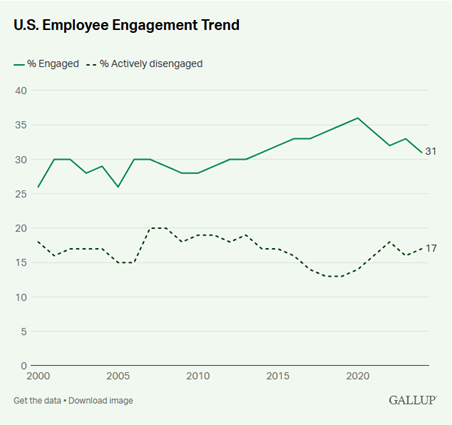
Stickiness hasn’t changed in the last quarter of a century. According to Gallup’s long running, annual surveys, employee engagement has remained around 30% and active disengagement around 17% since Y2K was a thing. Gallup’s surveys and others confirm that getting people to consistently participate at a higher level desperately needs to be improved.
Employee engagement is a prime area where improvement can benefit everyone. People are frustrated. Money and productivity are being lost due to low engagement and the negative impacts of a disengaged workforce show up at multiple levels beyond just the workplace.
Why haven’t we been able to move the needle on the levels of engagement? It’s not like we haven’t been trying. I, and many of my workforce development peers, have been preaching to employers for years the need to create an engaging workplace. And most have been sincere in their attempts to do this demanding work. Still, we hear very regularly that these same employers are struggling to find people who want to work, people who will stick around long enough to see the benefits and advantages of being on the team. Some, including the MikeroweWORKSFoundation, have lamented the loss of the will to work. Maybe we’ve been focusing too much on only one side of the equation.
Limits to an Engaging System
Each team member is a system, just as the organization is a system. When these two systems are integrated, both are impacted. So, the probability of success by the organization in building an engaging environment will be limited if the newly integrated systems do not share a common goal around, or even a unifying understanding of the purpose and value of work. If the individual system is unaware of how to engage, unable to engage, or unwilling to engage, how successful can the organizational system’s attempts at engagement be?
Focus on the Other Part of the Equation
Here’s a potentially controversial solution – let’s help individual team members appreciate the many values of work and why engaging at work is in their best interest. There are distinct and powerful reasons for individuals to pursue being engaged at work.
Beyond the obvious economic benefits, work is good for the health – physical, mental, and yes, spiritual health. A good day’s work influences positive feelings toward life. Workplace stress is well documented. How much of this might be relieved with a healthier view of work? Family life benefits when things are good at work. A different mindset about work could help promote this.
Work is an integral part of the human experience. Always has been, always will be. But it goes beyond just the part of work we get paid for. The theme of work runs all the way through the Christian scriptures starting with the first verse of Genesis. I’m no religious scholar, but a cursory search indicates that work is pretty prominent in many other belief systems as well. We need to help people take a holistic view of work. The whole person comes to the job, so the whole person should be taken into consideration, including the spiritual side.
Other Benefits
In future posts we’ll unpack some more details of the benefits and values of work. Looking at the definition of engagement is helpful. So too the way we measure it. Engagement at work is very much an emotional reaction. How do we feel about the work, the people, the mission, and vision of the organization? It is emotionally intelligent for everyone to engage at work. How might we bring EQ into the solution to this challenge? Other topics might find their way in as well. Your thoughts and insights could add immeasurably to this exploration, so I invite you to opine as we explore.
For years we have, in my opinion, pushed employee engagement mostly from the employers’ side of the equation. Certainly, there is still work to be done by employers; however, the other stakeholders must also take responsibility and do their part to engage and be engaged.
An Optimized People Development System can be a strong vehicle for change in this effort. Examining the concept of engagement while looking closely at the internal system we depend upon to find, train, and retain people can offer strategic opportunities for improvement. Improvements to the system and the philosophy under which it operates could certainly help the organization and each individual within it, stick together longer over a shared appreciation for the true scope and amazing values of work.
Image by Mohamed Hassan from Pixabay
 The Optimized People Development System
Leave a comment